
Wale Adeleke (w.adeleke@numerates.com.ng)
Two reflections on Makoko.
First.
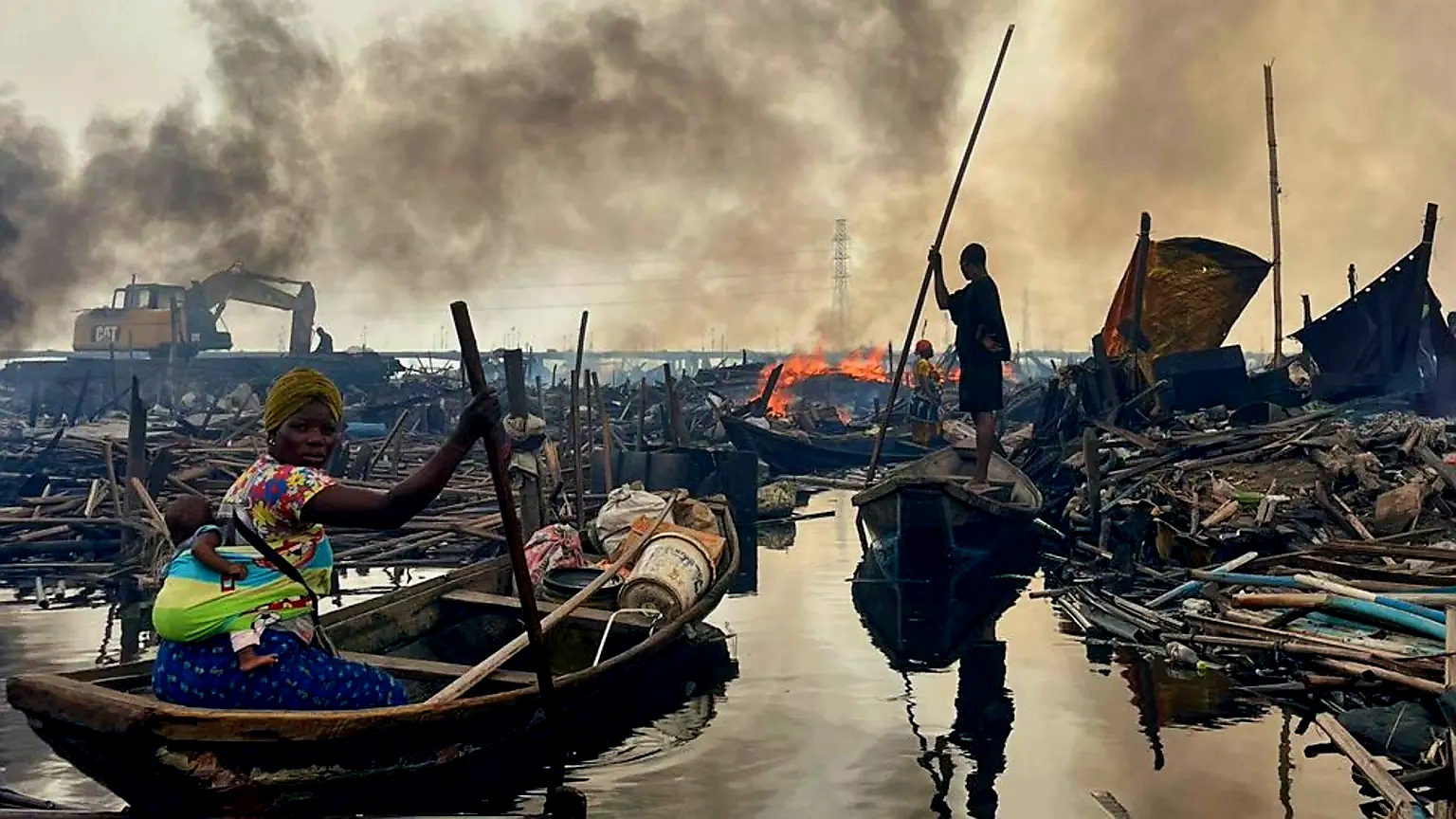
Watching the sheer scale of Makoko, the first question that comes to mind is simple: what were the government officials responsible for urban and physical planning thinking—and what were they waiting for?
It’s not as if Makoko is hidden in some distant swamp. No. It sits in the open—at the heart of the city. Informal settlements do not appear overnight; they expand slowly, visibly, and predictably. That an entire shanty community could grow to this size, in full public view, under the noses of officials paid to enforce physical planning laws, is nothing short of gross dereliction of duty. It is a sad reflection of our fire-brigade mentality: ignore problems until they explode, then respond with brute force.
In any decent society, the state’s failure to act early creates a moral obligation to act humanely later. Having allowed this community to form and persist, the government cannot simply erase it with fire and bulldozers. It owes the residents—especially families and children—not just eviction notices, but credible alternatives: relocation, resettlement, or compensation. Anything less is collective punishment for a failure the state itself created.
Oh yes, I remember the decent society factor. So, I get it. Knowing Nigeria, such expectations border on fantasy. Our government rarely holds itself accountable—neither for neglect nor for approving what it later claims to condemn.
And giving prior approval to what it later condemns and bulldozes is the real tragedy. Here, a textbook example.
The same government that hoards information about land acquisition, flood plains, and no-build zones is the same government whose officials will approve building plans on those very sites—only to later send in bulldozers to demolish them. This is worse than hypocrisy. It borders on institutional lunacy.
And no, I do not ask anyone to take my word for this. Just prove me wrong. Show me a LASG website where a citizen can enter GPS coordinates and instantly know whether a property falls on government acquisition, a floodplain, a protected easement, or whether there is an existing government-issued title.
In the past, governments at least erected signposts warning the public of acquisitions and easements. Today, even that minimal transparency has vanished. This opaqueness now feeds an extortion economy—where touts and corrupt civil servants across land agencies, survey offices, planning units, and title registries prey on innocent citizens who only want to build legally.
In a culture of impunity, officials who approve building plans on government-designated flood plains marked for no development are never sanctioned. But the innocent land developer is the one whose home is bulldozed.
Such is the plight of our society.
Second.
Our society has a troubling habit of recycling injustice.
Children who watch their homes burned and their lives uprooted—without dignity, remedy, or protection—do not simply “move on.” They carry that injury forward. And tragically, many grow up to occupy positions of authority where their duty is to prevent the very decay they once suffered.
And what do they do?
Growing up in a society that teaches them, early and brutally, that the law arrives only as punishment—never as protection— it is hardly surprising when they repeat the same cruelty.
And so the cycle continues:
state neglect → silent growth → sudden demolition → displaced families → new slums → fresh demolitions.
The other day, I read an account by a former military governor of Lagos State—Col. Raji (rtd), I believe—about how his administration bulldozed Maroko shanty town. That was over thirty years ago.
You would think by now the government would have learned: to intervene early, govern transparently, and act humanely—so that Maroko would remain an exception, not a blueprint.
But going by the recent tragedy at Makoko, it is clear: Maroko was never an exception. It is the template. And all along, we bought into the ~idea~ illusion that doing better than the previous generation is the ultimate test of societal progress. What an oversight.

1SUBSCRIBE TO OUR NEWSLETTER NOW
Support MATAZ ARISING’ journalism of integrity and credibility.
Good journalism ensure the possibility of a good society, an accountable democracy, and a transparent government.
We ask you to consider making a modest support to this noble endeavour.
TEXT AD: To advertise here – Email ad@matazarising.com
LATEST POSTS
-
British woman, unborn baby die in Nigeria; family seeks help to bring bodies home

MaTaZ ArIsInGDallas, Texas A 40-year-old British woman who relocated to Nigeria to start a new life with her husband has died alongside her unborn baby after developing sepsis. Claire Chadwick, who was 37 weeks pregnant, reportedly suffered septic shock after her baby girl died in the womb. In a report by Daily Mail UK, Chadwick…
-
Fani-Kayode, Seyi Tinubu, three others receive senior counsel rank

Seyi Tinubu
-
2027: Atiku, Peter Obi have nothing to offer Nigerians — Wike

MaTaZ ArIsInGDallas, Texas Wike said Obi lacked the capacity to provide alternative leadership, while Atiku failed to make meaningful contributions when he had the opportunity to serve in government. He made the remarks on Thursday during his monthly media chat in Port Harcourt, where he expressed confidence in President Bola Tinubu’s political strength ahead of…













 MaTaZ ArIsInGDallas, Texas Two reflections on Makoko. First.Watching the sheer scale of Makoko, the first question tha)