
…says exchange rate will reach N3,000 to one dollar
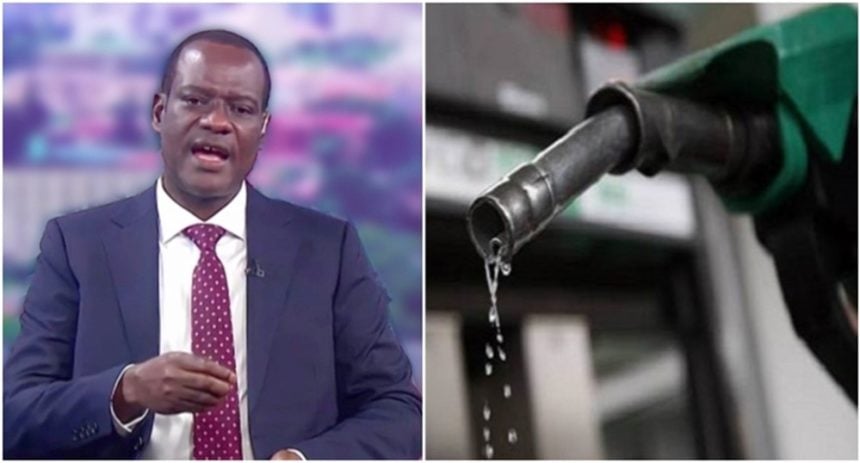
The Minister of Finance and the Coordinating Minister of Economy, Prof. Taiwo Oyedele has revealed that returning fuel subsidy would cost Nigeria government revenue of more than N16 trillion per year.
By Tyavzua Saanyol
Speaking on Thursday at a press briefing in Abuja, the Minister explained that crude, freight and refining inputs are all priced in dollars. To force the naira price down, the government must in effect subsidise the foreign exchange. That is the multiple exchange rate system that brought the economy close to a collapse before President Bola Ahmed Tinubu’s administration reformed it in 2023.
“To be clear, what is being proposed is not a production subsidy. A true production subsidy supports a producer who cannot compete at market prices. This is different, it is a discount on crude, passed through to the pump. That is a consumption subsidy by another route, with the same bill attached.
“Second, a subsidy hides volatility; it does not remove it. If the pump price is fixed while crude, freight and the exchange rate all move, the risk does not disappear. It moves onto the public balance sheet. With crude above 100 dollars, that commitment would be large and open-ended.
“Consider the arithmetic. Nigeria consumes roughly 50 million litres of petrol a day. To return petrol to its pre-reform price would cost more than 20 trillion naira a year, before any allowance for inflated consumption and smuggling. Even the 500 naira a litre that some have promised would cost over 16 trillion naira a year.
“Amounts of that size are nearly everything the Federation Account shared among all three tiers of government in 2025. The consequences for salaries, pensions, schools, hospitals and security are not hard to imagine”.
He said “our petrol is already far cheaper than in most neighbouring countries. Widen that gap, and Nigerian taxpayers would be subsidising motorists across our borders, as we did for years. Cheaper fuel would also raise consumption at home, at a time when global supply is tight. Excess consumption anywhere means higher prices everywhere, and that comes back to us as imported inflation.
“Subsidy removal released 15.8 trillion naira to the Federation Account between June 2023 and December 2025. Of that, 10.4 trillion went to states and local governments. In May 2023, 27 states could not reliably pay salaries.
“Today, none is in that position. At the federal level, about two-thirds of the savings combined with additional independent revenue and borrowing were utilised on spending that went directly to average Nigerians, through higher wages, infrastructure, electricity subsidy and social transfers. The balance went to stabilising the economy, mainly by way of higher cost of servicing debt as interest rates went up to tame rising inflation.
“Return subsidy and the sequence is familiar. Weaker revenue invites a sovereign credit downgrade, as the rating agencies have already signalled. That would put at risk the upgrades we have recently earned, including our first from S&P in fourteen years. Borrowing becomes costlier.
“Capital leaves. Reserves fall. The naira weakens. The progress on inflation, which has allowed the Central Bank to begin lowering interest rates, would be put at risk.
“Our estimate is that the exchange rate could approach 3,000 naira to the dollar within months, and so-called subsidised petrol would cost at least 2,000 naira a litre. That is well above what Nigerians pay today”.
Oyedele explained further that subsidy does not lower the cost of fuel. “It only changes how it is paid, and when. Nigerians have paid that bill before, in scarcity, in inflation and in a collapsing currency.
“However it is described, a subsidy must be financed: through salaries and pensions not paid on time, through higher taxes, or through the printing of money. Each of these has done great harm before. Short-term relief bought with long-term fragility is the most expensive money a government can spend” the Minister stated.
He noted that the pressure on fuel prices today began far from “our shores, in the Gulf, a conflict now in its eighth month. By mid-September, shipping through the Strait of Hormuz was running at roughly 13 percent of its pre-war level. Brent crude is trading at over 100 dollars a barrel, almost 50 percent higher than before the war.
“The squeeze is sharpest in refined products. Diesel exports from the Middle East and Russia are down 75 percent from a year ago. On the other hand, crude tanker rates from West Africa reached record highs in September as the world scrambled for supply outside the Gulf. Unfortunately, the International Energy Agency expects the pressure on refined products to last for months.
“No country has been spared. In the United States, diesel has reached a record 6.50 dollars a gallon, about 73 percent above its pre-war price. In the Philippines, diesel has nearly doubled. Bangladesh is paying close to three times the pre-war price for spot cargoes of gas.
“Closer to home, Zambia offers a lesson. Its government suspended fuel duties to hold prices down. When that relief ran out this month, pump prices rose by about 24 percent in a single adjustment. Relief that cannot be sustained does not remove the pain. It postpones it, and then delivers it all at once, often with greater force.
“Our own numbers tell the same story. Before the conflict, with crude near 70 dollars a barrel, petrol sold for about 830 naira a litre. Today it averages about 1,400 naira. That increase was caused by a global conflict in which we had no say. Ironically, without the removal of subsidy, the impact would have been far greater”.
The Minister noted that “for Nigeria, the impact of higher crude prices is mixed. It supports the budget and Federation revenue. But production is below forecast, and legacy crude commitments from the subsidy era absorb much of the gain. At the same time, households and businesses face higher fuel, transport and logistics costs, and the burden falls hardest on the most vulnerable.
“Yet there is one thing Nigerians have not faced through these months: queues. Fuel has remained available in every state. In a crisis of this kind, availability is the first form of affordability”.
He promised that measures being put in place by the federal government in coming days’ will ease the pressure of fuel prices on households.

1SUBSCRIBE TO OUR NEWSLETTER NOW
Support MATAZ ARISING’ journalism of integrity and credibility.
Good journalism ensure the possibility of a good society, an accountable democracy, and a transparent government.
We ask you to consider making a modest support to this noble endeavour.
TEXT AD: To advertise here – Email ad@matazarising.com
LATEST POSTS
-
FG announces 30-day petrol discount for transporters at NNPC filling stations

MaTaZ ArIsInGDallas, Texas The Federal Government has announced a 30-day discount on petrol sold by the Nigerian National Petroleum Company Limited, NNPCL, with public transport operators to receive priority under the arrangement. The Minister of Finance and Coordinating Minister of the Economy, Taiwo Oyedele, disclosed this on Thursday during a press briefing on petrol prices…
-
NLC gives FG ultimatum to cut petrol price, renegotiate minimum wage

MaTaZ ArIsInGDallas, Texas by Christian Appolos Nigeria Labour Congress (NLC) has given the Federal Government a two-week ultimatum to reduce the price of petrol and commence renegotiation of the national minimum wage, warning that it would be compelled to take further action if the demands are not met. The ultimatum, which takes effect from Friday,…
-
Nigeria must shift from consumption to production — Peter Obi

MaTaZ ArIsInGDallas, Texas Presidential candidate of the Nigeria Democratic Congress (NDC), Peter Obi, has called for deliberate policies to transform Nigeria from a consumption-driven economy into a productive economy capable of creating jobs, increasing exports and competing in the global market. Obi made the call after attending the inauguration of the newly elected President of…