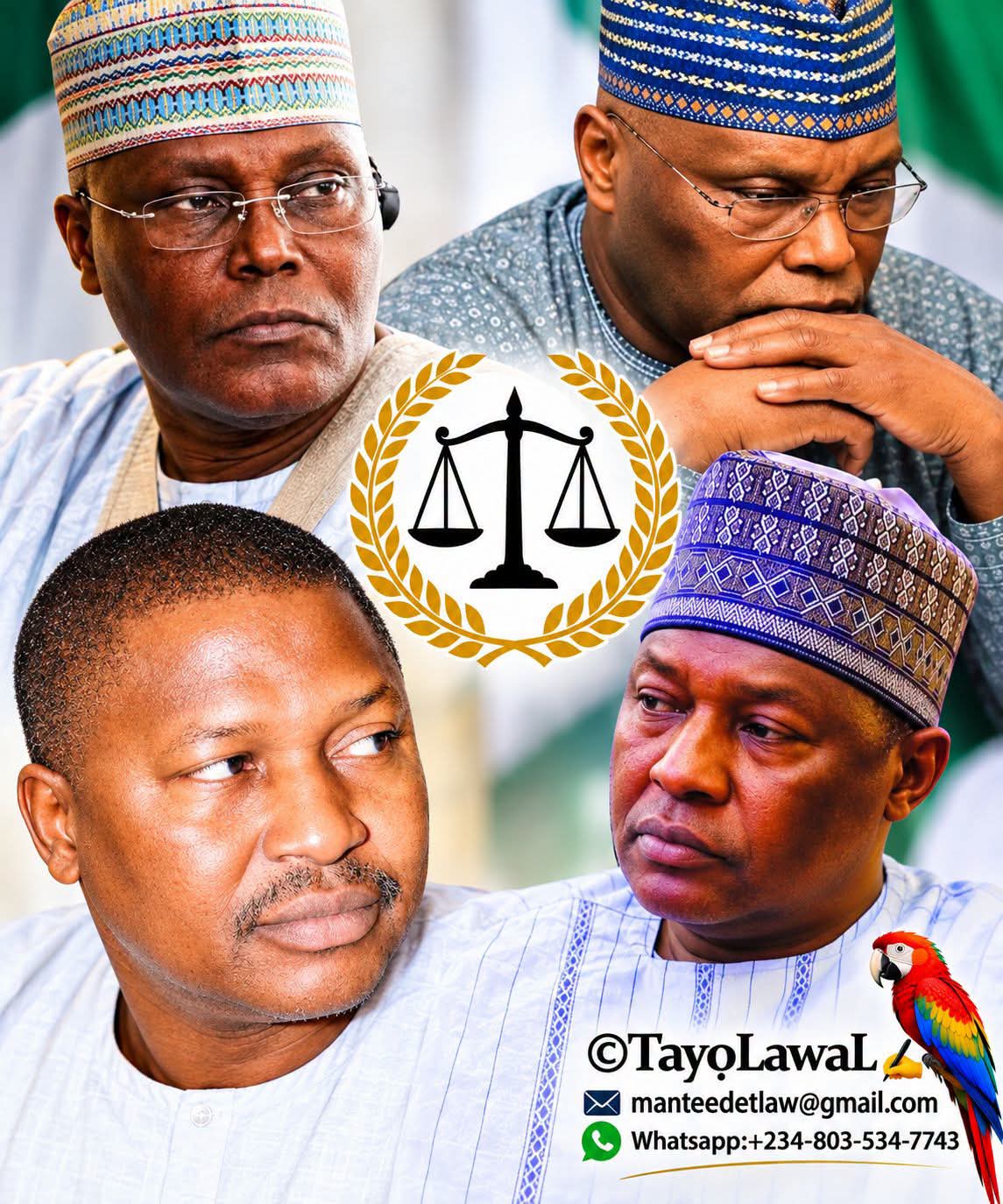
Atiku Abubakar, Abubakar Malami: How Not To Be A Good Citizen
“Cry, the beloved country, for the unborn child that is the inheritor of our fear.” – Alan Paton, Cry, the Beloved Country
We were raised on a simple idea of what a good citizen is.
You pay your tax.
Even when the road to the tax office
is the same road you are paying tax to repair.
You keep your compound clean.
You greet your neighbour.
You don’t bribe the policeman at the checkpoint.
Or you try not to.
You stand when the anthem plays.
You speak well of the country abroad.
You stay.
Or if you leave, you send money home
and promise yourself you will come back.
That is what we teach our children.
It is not wrong.
It is incomplete.
Because there is another citizen.
The one given power.
For him the list is different.
He swears an oath.
He holds something in trust.
The money is not his.
The contract is not his.
The dam is not his to give.
And the country is not his to trade.
When he signs a paper,
he signs it in your name and in mine.
The way a caretaker signs
for a house he does not own.
We spend enormous energy
defining the duties of the ordinary citizen
and almost none
defining the duty of that man.
Which is how a country ends up
with citizens who pay their tax
and leaders who sell the road.
Yesterday I wrote about the Mambilla victory.
I called it light at last.
Today I want to write about why it took twenty-three years.
Two files show what happens
when that duty is tested.
They did not age well.
A word on what these files are.
Because I am angry.
And anger makes liars of all of us.
The findings against Abubakar Malami,
former attorney-general,
are those of an ICC arbitral tribunal
sitting in Paris,
reported by TheCable.
They are not a criminal conviction.
He denies them.
The allegations against Atiku Abubakar,
former vice-president,
come from an APC Presidential Campaign Council statement
issued on September 18, 2026,
signed by Dele Alake.
A campaign document.
In an election season.
Nobody has been tried.
That, in a way,
is the whole problem.
Let me start with Malami.
In January 2020,
Nigeria agreed to pay Sunrise Power
$200 million.
One instalment.
Default would reinstate Sunrise
as exclusive local content partner for Mambilla
and attract 10 percent interest,
compounded annually.
Two months later,
an addendum.
Two instalments of $100 million.
An extra $200 million penalty on default.
And interest at 10 percent –
compounded daily.
A chief law officer
turned a $200 million debt
into a $400 million debt
and bolted on a penalty.
The tribunal went looking
for the Nigerian benefit.
Found nada. (none)
“The Tribunal is unable to discern
any upside for Nigeria
in the renegotiated terms and conditions.”
Then the sentence that should follow him for life.
That he “has not been negotiating
on behalf of Nigeria
when he insisted on a change
of the terms and conditions
of the settlement
but for Sunrise.”
His conduct, the tribunal said,
showed he
“was motivated by other incentive(s).”
Incentive.
In brackets.
A polite word
for something ugly.
And he knew who he was dealing with.
In January 2018,
he had written to Buhari’s chief of staff
describing Leno Adesanya,
Sunrise’s promoter,
as “a criminal of the highest order”
and the “number 1 enemy” of Mambilla.
Two years later,
he was signing agreements with him.
The tribunal observed
that the attorney-general had come to treat
a man he once called a criminal
as a trusted partner.
And wanted him to explain the journey.
He did not come.
He filed a witness statement
and refused cross-examination,
citing an EFCC investigation –
while sitting in the same city as the hearing,
having travelled there with Buhari,
his father-in-law,
who did testify.
The tribunal recorded
its “serious dissatisfaction.”
Then the part
that made me put the paper down.
Shortly after signing,
Malami issued handwritten instructions
to stagger the payment.
$100 million first.
The rest later.
Nothing had happened, the tribunal found,
to justify reopening an agreement
whose “ink was barely dry.”
It called the instruction
“suspicious.”
Adesanya testified
that Malami solicited a bribe
and asked for a share of the settlement.
And that he had recordings
in which Malami and the then power minister,
Saleh Mamman,
since convicted in a separate case,
allegedly said Nigeria would pay $100 million first
and release the rest
after Adesanya had done
“what is needed.”
Adesanya refused to produce the recordings,
citing fear for his family.
The tribunal drew an adverse inference –
then noticed something
no one should be able to notice.
The two-instalment split
matched the alleged demand
exactly.
Its conclusion:
“the Tribunal has no reason to doubt
the veracity of Mr. Adesanya’s testimony
to the effect that Attorney-General Malami
solicited a bribe.”
Read that again.
Not unproven.
Not insufficient.
No reason to doubt.
Meanwhile Nigeria and Sunrise
were opposing parties.
In November 2021,
Adesanya wrote asking Malami
to disengage Nigeria’s own lawyers,
White & Case,
and Supo Shasore,
thanking him for his
“recent efforts to see that we get paid.”
Malami replied:
“Thank you Mr Leno.”
The tribunal found it
“wholly inappropriate.”
Then said something
that will stay with me
longer than any legal finding.
The two men
“shared a high degree of trust
and, it would appear,
a lack of moral compass.”
It found that “we” –
as in we get paid –
meant both of them.
Buhari, for his part,
kept saying no.
In April 2020 he declined,
saying government did not have the money.
In January 2021,
Malami came back.
Buhari wrote two words.
“Not approved.”
Those words, the tribunal said,
“leave no room for interpretation.”
It called Malami’s persistence
“remarkable.”
It also found he had told the president
the settlement would cost $200 million
and save $2.154 billion –
when the addendum already provided
for $400 million
plus daily interest.
Five red flags.
A “corrupt relation.”
An agreement that was
“a product of corruption.”
Nigeria’s counterclaim for damages
failed for want of proof.
Sunrise was ordered to refund
$11.82 million in legal fees.
A rebate on a wound.
Cry, my beloved country.
Now the other name.
And here I have to be honest with you.
Because this is where the essay
could become something
I don’t want it to be.
I have read the APC statement three times
and I still cannot decide
whether it is evidence or electioneering.
It was issued in a campaign season,
by a party with everything to gain,
and it reaches back twenty-three years.
Some of it
I simply do not know how to verify.
But there is one claim
I cannot shake.
That in 2003,
in the last weeks of Ọbasanjọ’s first term,
Atiku and the then power minister,
Olu Agunloye,
“worked in cahoots to sign
an illegal power contract with Sunrise” –
over the objections of the president
and the Federal Executive Council.
I think about what that room
must have felt like.
A president saying no.
A council saying no.
And still a signature.
In the dying days of a tenure.
On a project
nobody would live to see built.
The statement says
Leno Adesanya,
through an offshore account
called China Castle Investment,
wired $500,000
to the US Citibank account
of Atiku’s then wife,
Jennifer Douglas.
And that the transfers surfaced
in a US Senate investigation,
Keeping Foreign Corruption out of the United States:
Four Case Histories.
It quotes the tribunal:
“There is a close connection in time
between the moment the USD 500,000 payment
was made to the wife of Vice-President Abubakar
on 30 January 2003
and the alleged award of the BOT contract to Sunrise
on 22 May 2003.”
It calls this a “treasonable act.”
Notes Sunrise later demanded $680 million
and over $2.7 billion.
And compares it to P&ID –
the phantom gas project
that nearly cost us $11 billion
for nothing.
Then it does something
I find both effective and slightly cheap.
It reaches for Ọbasanjọ’s My Watch,
quoting his verdict
on his own former deputy.
A “propensity to corruption.”
“Disloyalty.”
“Poor judgement.”
“Lack of transparency.”
And a “readiness to sacrifice
morality, integrity, propriety, truth
and national interest
for self and selfish interest.”
Cheap, because it is one old enemy
quoting another.
Effective, because that sentence
has sat there since 2014,
and nothing in this story
contradicts it.
So what does any of this
have to do with being a citizen?
Everything, if you believe
public office is a trust.
For Sunrise,
the sun has finally set.
The company that took its name
from daybreak
came to Paris asking for $400 million,
a penalty,
and interest compounding daily.
The tribunal heard it all
and said no.
Claims rejected in their entirety.
Plus $11.82 million in legal fees
to refund.
The dawn-chaser got an evening.
I will take my pleasures
where I can find them.
But a sunset is not light.
When the sun goes down on Sunrise,
it goes down on Taraba too.
The girl is still doing her homework
by the glow of a phone.
Her brother is still in Lagos.
The dam is still a rumour.
And that is the thing
about winning like this.
Nigeria walked out of Paris
with a victory and a refund,
and nobody has had to answer
for why we were there at all.
No arrest.
No charge.
No resignation.
Just a 616-page award,
a campaign statement,
and the same men
saying the same things.
The sun set on Sunrise.
It is still dark in Taraba.
And that –
letting the sun go down
on your own country
and calling it a win –
is how not to be
a good citizen.
#MambillaAward
#HowNotToBeAGoodCitizen
#Malami
#SunriseSunset
#StillDarkInTaraba
#PublicOfficeIsATrust
#TwentyThreeYears
#NigeriaCannotBeRobbed
©TayọLawaL ✍️ manteedetlaw@gmail.com Whatsapp:+234-803-534-7743

1SUBSCRIBE TO OUR NEWSLETTER NOW
Support MATAZ ARISING’ journalism of integrity and credibility.
Good journalism ensure the possibility of a good society, an accountable democracy, and a transparent government.
We ask you to consider making a modest support to this noble endeavour.
TEXT AD: To advertise here – Email ad@matazarising.com
LATEST POSTS
-
Tinubu mandates Shettima to lead Nigeria’s delegation to UNGA

MaTaZ ArIsInGDallas, Texas By Saheed Oyelakin President Bola Tinubu has mandated Vice President Kashim Shettima to represent him and lead Nigeria’s delegation to the 81st Session of the United Nations General Assembly in New York, United States. The development ends weeks of speculation over whether Tinubu would personally attend the annual gathering of world leaders. Nigeria’s…
-
Shehu Sani tells truth to his North

MaTaZ ArIsInGDallas, Texas Monday Lines By Lasisi Olagunju (Published in the Nigerian Tribune on Monday, 21 September, 2026). ‘Truth Is Trouble’ is Professor Niyi Osundare’s latest book. What the poet laureate says in English, we say in another sense in Yoruba: Òótọ́ korò, truth is bitter. Then there is Ayékòótọ́, the name we give the…
-
Atiku Abubakar, Abubakar Malami: How Not To Be A Good Citizen
MaTaZ ArIsInGDallas, Texas Atiku Abubakar, Abubakar Malami: How Not To Be A Good Citizen “Cry, the beloved country, for the unborn child that is the inheritor of our fear.” – Alan Paton, Cry, the Beloved Country We were raised on a simple idea of what a good citizen is. You pay your tax.Even when the…