

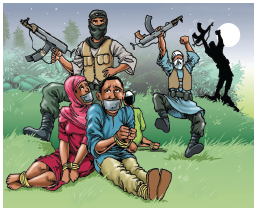
· A decisive action is required to curb the escalating wave of kidnappings, argues ABIODUN OLUWADARE

The recent decision by the Edo State House of Assembly to approve death sentence as punishment for kidnapping is a commendable and long-overdue step in addressing one of Nigeria’s most pressing security challenges. Kidnapping has become an existential threat to national stability, eroding public confidence in the rule of law and the fundamental human right to freedom of movement. If left unchecked, it has the potential to destabilize not just individual states but the entire federation.
Nigeria, once a nation where people travelled freely without fear, has been gripped by a crisis of insecurity. The surge in kidnapping incidents has disrupted daily life, crippled businesses, and imposed severe emotional and financial burdens on victims and their families. The situation has deteriorated to the extent that many citizens now fear travelling even short distances, unsure if they will reach their destinations safely. This is a national disgrace that must be addressed with all available legal instruments.
Beyond the direct impact on victims and their families, the worsening security landscape has led to the militarization of daily life, with citizens increasingly relying on vigilante groups and paramilitary forces for protection. This fragmentation of security provisions weakens the state’s authority and fuels a dangerous cycle of violence.
The severity of kidnapping and its impact on society necessitate the harshest penalties. Criminals have turned kidnapping into a lucrative industry, operating with impunity and often enjoying the protection of influential backers. This has made the crime even more difficult to combat through conventional law enforcement measures. The reintroduction of the death penalty as a deterrent is not just necessary—it is a moral imperative.
Historical precedents support this approach. During the 1970s, the administration of General Yakubu Gowon implemented capital punishment for armed robbery. This firm stance significantly curbed the menace at the time, sending a clear message that the state would not tolerate acts that threatened public safety and order. Similar decisive action is required today to curb the escalating wave of kidnappings.
Furthermore, in countries where capital punishment has been strictly enforced for violent crimes, such as China and Saudi Arabia, crime rates have seen noticeable declines. While some human rights activists argue against capital punishment, the unique security situation in Nigeria demands exceptional measures. The right to life must be protected, but so must the right of innocent citizens to live without the constant fear of abduction and violence.
One critical but often overlooked aspect of the fight against kidnapping is the role of communication service providers (CSPs). Kidnappers frequently use mobile phones to communicate with victims’ families, coordinate their operations, and negotiate ransom payments. Unfortunately, telecom companies in Nigeria have not been proactive in leveraging technology to combat this menace.
In advanced nations, law enforcement agencies work closely with telecom providers to track and apprehend criminals. For instance, when U.S. troops successfully rescued a kidnapped American citizen in Niger State, intelligence gathering and real-time tracking played a crucial role. This raises the question: why are Nigerian telecom companies unable to provide similar support? With modern surveillance tools, geolocation technology, and call-tracking capabilities, CSPs can significantly aid security agencies in identifying and dismantling kidnapping syndicates.
Telecom companies must be held accountable for their role in national security. The government should enforce policies mandating real-time tracking of suspected criminals and require telecom firms to cooperate fully with law enforcement without unnecessary bureaucratic delays. Additionally, stricter regulations should be imposed on SIM card registration to prevent criminals from using unregistered or fraudulently obtained phone numbers to evade detection.
Kidnapping has had devastating effects on Nigeria’s social, economic, and political fabric. Families and communities have been torn apart by the trauma and financial strain of paying ransom for the release of loved ones. Trust among citizens has eroded, as individuals fear betrayal by those closest to them, given the growing trend of insider involvement in abductions.

SUBSCRIBE TO OUR NEWSLETTER NOW
Support MATAZ ARISING’ journalism of integrity and credibility.
Good journalism ensure the possibility of a good society, an accountable democracy, and a transparent government.
We ask you to consider making a modest support to this noble endeavour.
TEXT AD: To advertise here – Email ad@matazarising.com
LATEST POSTS
-
Afrophobia: Should Nigeria ask South African companies to leave?

MaTaZ ArIsInGDallas, Texas Monday Lines 2 Afrophobia: Should Nigeria ask South African companies to leave? By Lasisi Olagunju (Published in the Nigerian Tribune on Monday, 6 July, 2026). Jacob Zuma was President of South Africa when he declared on October 21, 2013 that South Africa should not “think like Africans in Africa, generally.” The remark,…
-
Why I did not take Brazil’s penalty against Norway – Vinicius
MaTaZ ArIsInGDallas, Texas Brazil’s hopes of ending their long wait for World Cup glory came to a painful end after a 2-1 defeat to Norway in the Round of 16, with Erling Haaland scoring twice to eliminate the five-time champions. The aftermath of the defeat was dominated by questions over why Vinicius Júnior did not…
-
Blatter questions ‘political power’ after Trump’s FIFA phone call
MaTaZ ArIsInGDallas, Texas Disgraced former FIFA president Sepp Blatter said on Monday he questioned the football governing body’s decision to suspend US striker Folarin Balogun’s red card ban. Sources told AFP US President Donald Trump had called FIFA’s current chief Gianni Infantino to ask FIFA to review Balogun’s automatic one-game suspension. The 25-year-old is now…