

BY AZUKA ONWUKA (July 15, 2014
JULY 15, 2014 BY AZUKA ONWUKA
Recently, the National Conference unanimously adopted a return to the old national anthem, known as, “Nigeria, We Hail Thee.” To buttress their love for that anthem, the delegates rose to their feet in unison and sang its first stanza with glee.
It was an emotional sight filled with nostalgia.
What is special about this anthem? Let us look at the wordings to help us get a clearer picture:
Nigeria, we hail thee,
Our own dear native land,
Though tribe and tongue may differ,
In brotherhood we stand,
Nigerians all, and proud to serve
Our sovereign Motherland.
Our flag shall be a symbol
That truth and justice reign,
In peace or battle honour’d,
And this we count as gain,
To hand on to our children
A banner without stain.
The lyrics of this anthem were written by Lillian Jean Williams who was resident in Nigeria at the time of independence in 1960. Frances Berda composed the music. This anthem was used in Nigeria from independence until 1978, when it was replaced with “Arise, O Compatriots”.
It is rare to see any Nigerian born before the mid 1970s who does not prefer the old national anthem to the current one. The old national anthem is more melodious, more emotional, more nationalistic, more inspiring and deeper in meaning than the current anthem. It also reminds those who sang it in their school days how lovely Nigeria was before the Civil War; how lovely it was even after the Civil War when the Nigerian pound, and later the Nigerian naira, was stronger than the American dollar; how students had bursary, lived two in university rooms, and were served milk, chicken and fruits as part of their meals; how only those who were not intelligent enough to gain admission into Nigerian universities were mainly those who ran to the United States for studies; and how citizens of other African countries who had apartheid problems, economic problems and war problems ran into Nigeria for refuge.
I had written two articles in the past, suggesting that our current national anthem be dropped. It is too bland to be a national anthem. Its wordings are impersonal, unemotional and uninspiring. An anthem should praise the institution it is meant for or the people and urge them to serve and project or defend that institution. That is one of the reasons people like footballers shed tears when they hear their national anthem played before a football match.
But most importantly, the lyrics of the old anthem emphasise those issues that make a nation great: a nation that is dear to its nationals; taking pride in service to one’s nation; respect for the national flag; having a nation where truth and justice reign; praying for the nation; building a nation where nobody is oppressed; and having a nation blessed with peace and wealth.
The change from the old national anthem to the new one was more about misplaced national pride than functionality. There were those who felt that the fact that the anthem was composed by a Briton, it must be jettisoned as a colonial heritage. If the old anthem was changed because it was composed by the colonialists, why was the name Nigeria not changed too because it was coined by colonialists? Why was the amalgamation of 1914 not reversed because it was also executed by colonialists? Why has English not been dropped as our national language because it is a colonial heritage?
There is no doubt that if the new national anthem were more inspiring and melodious than the old national anthem, most Nigerians would not be asking for a return to the old anthem. After all, is anybody asking that we return to the use of pounds or right-hand drive of the British?
However, if Nigeria must return to the old national anthem, a surgery needs to be done on it by musicologists. The wordings of the old anthem betray the fact that the anthem was composed by a non-Nigerian.
The first is the use of “native land.” The word “natives” was usually used by colonialists to describe the people they were colonising. It has a pejorative connotation. “Locals” or “indigenous people” or “citizens” are preferable. “Native land” is also the way an immigrant refers to his home country. That makes it sound as if the national anthem is being sung by people living in a foreign land.
It will, therefore, be better to change “Our own dear native land” to “Our own dear fatherland” or “Our blessed land of birth.” That will ensure that the rhythm is maintained. Other suggestions can be made by music and language experts to replace “native land” appropriately without losing rhythm and meaning. However, using “fatherland” in the second line and ending the first stanza with “motherland” would also help to take care of those who think that if it is only their mother that is Nigerian by birth, they cannot be Nigerians. President Jerry Rawlings of Ghana and President Barack Obama of the United States are a few examples of those who claim the countries of their mothers instead of their fathers.
Calling Nigeria both “fatherland” and “motherland” in our anthem would also help to balance the nation as not too masculine and unfeeling like a man or too soft and emotional like a woman. As both our fatherland and motherland, Nigeria would have a rounded persona: when we need the pampering of a mother, Nigeria is there; and when we want the firmness and protection of a father, Nigeria is there.
The second word in the old anthem that needs to be expunged is “tribe.” “Tribe” is derogatory. A group of monkeys is called a tribe of monkeys or a troop of monkeys. The white colonialists used “tribe” to refer to the colonised peoples of Africa, whom they saw as primitive and uncivilised peoples living in remote undeveloped places. “Tribe” connotes lack of civilisation. It connotes colonialism. That is why many people prefer the use of “ethnic group” or “nation” instead.
Furthermore, “tribe and tongue” in the expression “though tribe and tongue may differ” point to a people and their language. Each ethnic group has its own language. For example, the Igbo are a people, and their tongue (language) is also Igbo. The Yoruba are a people and their language is Yoruba. Therefore, there is no need repeating that “tribe and tongue may differ.”
The two major points of difference among Nigerians are ethnicity and religion, not ethnicity and language. No matter how well an Ibibio man speaks Yoruba, he is not a Yoruba man; and no matter how well a Kanuri woman speaks Igbo, she is not an Igbo woman (unless by marriage.)
The anthem should therefore read: “Though creed and tongue may differ….” The use of “creed” captures religion, which is a major source of crisis in Nigeria. That will help to tell those who use religion to create divisions that they are breaching the tenets of the national anthem they sing regularly. Practise your religion and allow other people to practise theirs. In spite of religious differences, we are brothers and sisters in one nation. That way, peace reigns.
Nigerians have continually said and shown that they don’t like the current national anthem. The citizens of a nation deserve an anthem of their choice: an anthem that inspires them and makes them feel good about their nation. Let them be given the old national anthem. But let the anthem be edited to remove all words that have controversial connotations.
COMMENT: What I will change is the word TRIBE for NATION. Ayo Dada

WhatsApp Community
SUBSCRIBE TO OUR NEWSLETTER NOW
Support MATAZ ARISING’ journalism of integrity and credibility.
Good journalism ensure the possibility of a good society, an accountable democracy, and a transparent government.
We ask you to consider making a modest support to this noble endeavour.
TEXT AD: To advertise here – Email ad@matazarising.com
-
NYSC: Deployment to states’ll be guided by risk assessment — TINUBU

MaTaZ ArIsInGDallas, Texas By Johnbosco Agbakwuru ABUJA— PRESIDENT Bola Tinubu has said as part of the reform of the National Youth Service Corps, NYSC, corps members would now be deployed to security-challenged states, guided by risk assessment. He also reiterated that the scheme would be led by a civilian director-general and not military personnel as it…
-
Presidency exposes alleged fake Presidential Council

MaTaZ ArIsInGDallas, Texas …Says police charged Self-styled DG with forgery The Presidency on Wednesday dismissed renewed claims by Adeyemi Adeniyi Matthew that he was appointed to head a presidential agency, insisting he is an impostor who allegedly forged official documents to present himself as Director-General of a non-existent Presidential Foreign Intervention Promotion Council, also described as the…
-
Just in: Atiku appoints Kenneth Okonkwo as spokesperson
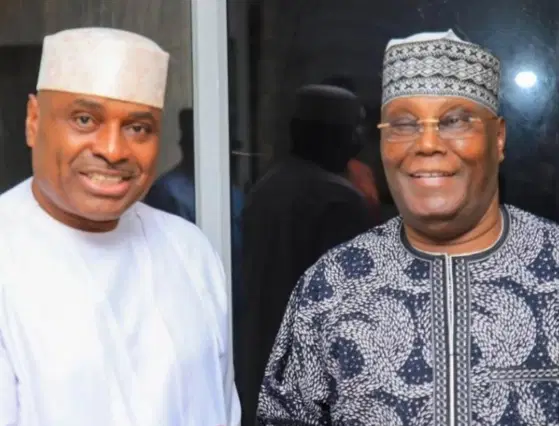
MaTaZ ArIsInGDallas, Texas Former Vice President and African Democratic Congress (ADC) presidential candidate for the 2027 election, Atiku Abubakar, has appointed actor-turned-politician and ADC chieftain Kenneth Okonkwo as his spokesperson. Okonkwo announced the appointment in a statement posted on his official X handle on Thursday, expressing appreciation to Atiku for the confidence reposed in him.…


 Nigerian National Anthem: Why it is the right call)