By Fred Itua, Abuja
After every election promise, the ordinary Nigerian often asks a simple question, “How far?” Not how long the document is, or how fine the English turns but, but how far it will go in his pocket, on his road, in his clinic and in his light bulb.
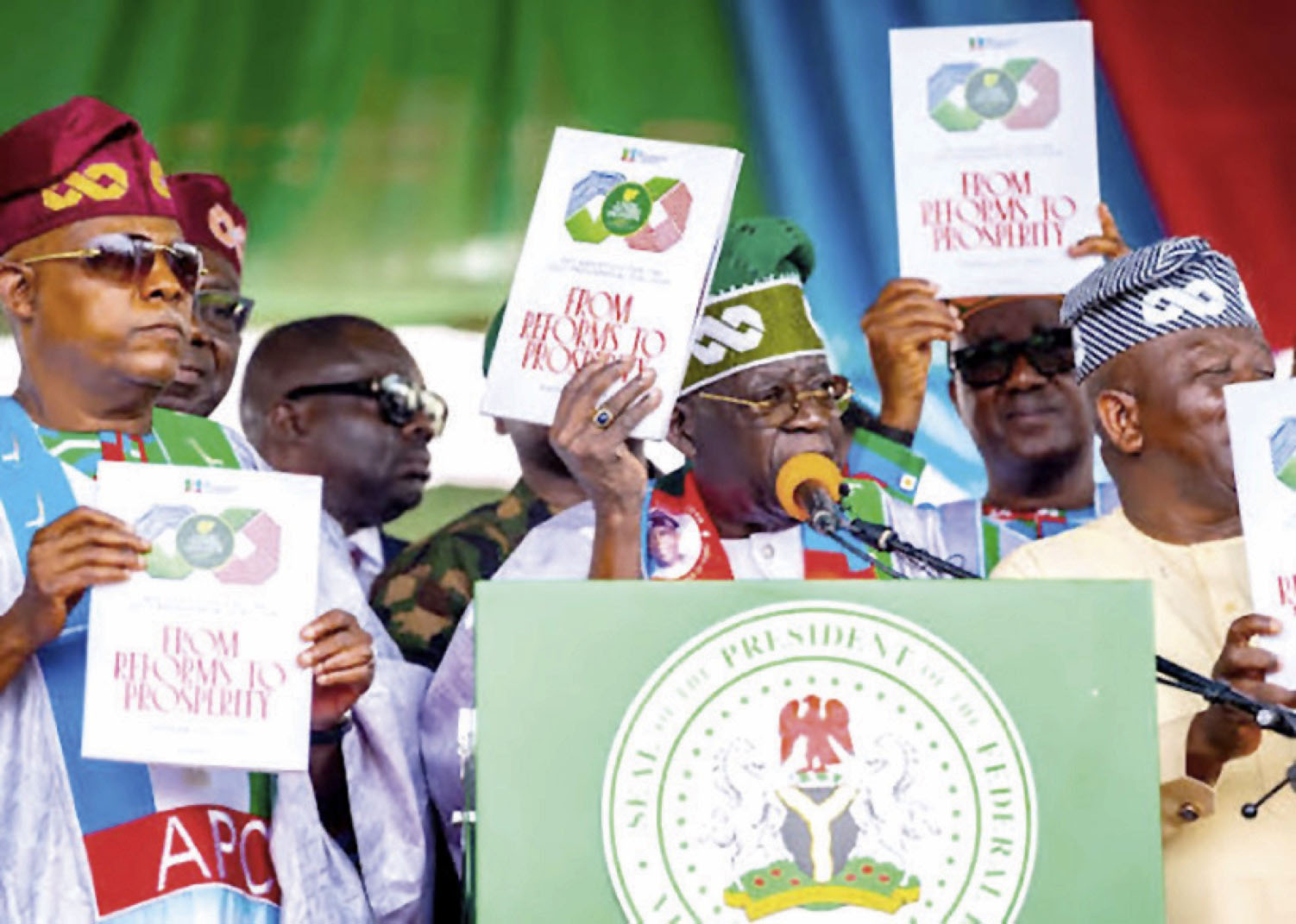
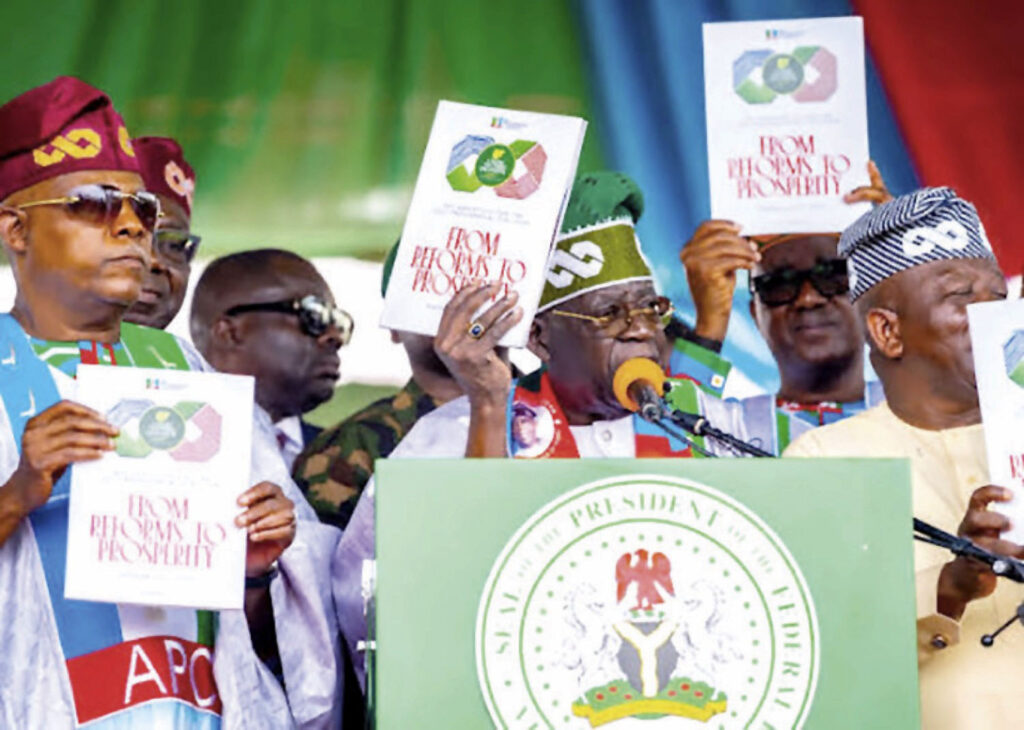
That question is now at the door of the All Progressives Congress (APC) and President Bola Ahmed Tinubu. The party has released its manifesto for the 2027 election, titled “From Reforms to Prosperity: Agenda 2027-2031”. The document, dated October 2026, is the programme for a second term. It claimed that the first four years were the time for hard decisions, and the next four must be the time for visible results.
In his opening message, the President described the 2023 decisions to remove the fuel subsidy, unify the exchange rate and reform tax policy as “heavy choices”. He said they were taken so that future generations would inherit a country that can stand on its own feet. He now wants Nigerians to focus on what he calls the food on the table, the power in the home, the security of the family and the dignity of work.
This analysis walks through the manifesto point by point. For each of the four pillars, it looks at what was promised in 2023, what the party says it has done, what it now promises, and what could make the promise real or stand in its way.
From eight points to four pillars
In 2023, the APC candidate presented an 80-page plan called “Renewed Hope 2023 – Action Plan for a Better Nigeria”. It spoke of ending fuel subsidy, fixing the forex problem, creating jobs and tackling insecurity. It later became the eight-point Renewed Hope Agenda of the government.
The 2027 document keeps those ideas but packs them into four pillars: a Secure and Resilient Nation; a Better Quality and More Affordable Life; Energy, Infrastructure and Economic Growth; and Effective and Accountable Governance.
It was noted that many 2023 commitments have returned in 2027, but with fresh targets and timelines. Housing, electricity, highways, food prices and youth enterprise are good examples of some of them. So, what has really changed? Mostly it is the style of the promise.
The 2023 plan was built on eight priority areas, with broad aims and few dates. The 2027 manifesto has four pillars, each laid out the same way, with baselines, targets and dates, many of them for 2030 or 2031. The 2023 document told Nigerians what would be done. The 2027 document adds a list of what the party is saying has been done, and promises that indicators will be published every year.
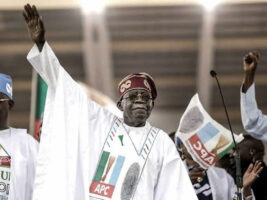
The Chief of Staff to the President, Femi Gbajabiamila, at its unveiling, called the document a binding pact. He urged Nigerians to judge the party by the promises it has kept, and said the manifesto commits the government to publish targets, name those responsible and report progress. Whether one likes the party or not, that is a standard that voters can use.
Pillar one: The security promise
The pledge is that every citizen should be able to live, work, travel, learn and worship in greater safety. The manifesto puts it in everyday terms; a farmer reaching his farm without fear, a trader moving goods safely, a child secure in the classroom. The document lists 8,166 hostages rescued by the Armed Forces and 8,500 community-policing officers trained, with committees in all 36 states and the FCT.
According to the document, the Army has grown from eight to twelve divisions. More than 530 mining sites have been identified, 420 are protected by Mining Marshals, and there have been 1,205 arrests and 152 prosecutions. Of 16,281 complaints sent to the Police Complaints Response Unit, 13,376 were resolved. Passport processing is down from six weeks to four days.
Going forward, the party is offering something new. It said it will cover the remaining 31 of 190 mapped border areas with electronic surveillance. Watch pipelines, power lines, railways, schools and health centres in real time. Produce more ammunition, armoured vehicles and drones at home. Raise salaries and improve housing for soldiers and police, and pay insurance and pension claims of fallen personnel faster. Four new army divisions and 28,000 more soldiers have been approved; 50,000 newly recruited police officers, moving toward one officer for every 400 citizens; and 30,150 approved Civil Defence personnel.
The manifesto wants 95 per cent of citizens and legal residents in the National Identity Database, up from 137,260,026 enrolled in June 2026. This may look like a small item, but it matters for security. It is hard to track crime when the state cannot easily confirm who is who.
Training and recruiting are things the government controls. Peace in villages and farm settlements is harder, because it also depends on intelligence, on cooperation between federal and state authorities, and on how quickly new officers reach the places that need them. The manifesto’s own tables give Nigerians a way to check each year whether the numbers are moving.
Pillar two: The cost-of-living promise
There is a new pledge. Safer communities, lower living costs, more chances to earn, and public services that work. This is the pillar closest to the kitchen, the hospital bed and the school gate.
On food security, the plan builds on the Guaranteed Minimum Price scheme and a strategic grain reserve, with the levels and releases to be published. It adds a monthly staple-food price tracker and efforts to reduce post-harvest losses through storage and cold chains. The manifesto notes that more than 449,000 metric tonnes of fertiliser inputs were mobilised by May 2026. It also states that inflation was 14.63 per cent in September 2026, down from a peak of 34.8 per cent in December 2024, and sets a goal of single digits, no higher than 8 per cent, by the end of 2031.
On health, the targets are specific. Working primary health centres should rise from 53 per cent toward 90 per cent. Basic Health Care Provision Fund support should reach all 17,600 centres, up from about 8,300. Health-insurance cover should grow from over 23 million people to 40 per cent of the population. Out-of-pocket spending should fall from 71 per cent to below 50 per cent. Free emergency obstetric care should grow from 172 to all 774 local government areas, and oncology centres should be completed in all geopolitical zones.
On jobs and youth, the plan is to halve youth unemployment by 2031 through a national strategy with published yearly targets, train two million young people, and reach 30 million Nigerians with digital literacy. It also promises to review the NYSC to make it more skills-driven.
On women and the vulnerable, the party promises at least 35 per cent women in the next Cabinet and major agencies, with a legal pathway and a public dashboard. It promises Sexual Assault Referral Centres nationwide. On welfare, it wants 20 million or more people verified on the National Social Register by 2030, wider cash transfers beyond the 10 million already reached, the $1 billion HOPE-SP programme starting with emergency transfers to 7.6 million households, and enforcement of the ₦70,000 minimum wage.
On housing, the party said more than 15,000 units are under construction on 14 sites. It then promises the Tinubu Mass Social Housing Scheme, with 200 units in each of the 774 local government areas (154,800 units), working toward 200,000 homes tracked on a public dashboard. The mortgage ceiling is to rise from ₦50 million to ₦85 million, and National Housing Fund contributors from six million to 10 million by 2028.
These promises depend on money and on states. Many health centres, schools and housing sites sit under state governments, so the federal plan is only as strong as the cooperation it gets. Prices are also something households feel every week, which means progress on food will be judged quickly. The price tracker and the dashboards are the tools to follow.
Pillar three: Power, roads and jobs
The pledge is that an economy that produces more, creates more jobs and lowers the cost of doing business and of daily living. The manifesto links this to reliable energy, modern infrastructure, productive farms and factories, and stronger trade links.
On power, it reports peak generation of 5,801.84 MW, up from about 4,211 MW in 2023, with 7.74 million customers metered (61.51 per cent) and more than 2.1 million new connections. It says 16 states now run their own electricity markets under the Electricity Act 2023. On oil and gas, it reports crude output of 1.56 million barrels a day in June 2026, the highest since 2020, and more than 140 CNG centres, up from 7. On roads, rail and ports, it points to 151.64 km of the Lagos–Calabar Coastal Highway paved in concrete, the 227 km Abuja–Makurdi toll road, and Lagos port vessel turnaround cut from five days to 2.7 days.
On the wider economy, the manifesto states that GDP growth of 4.43 per cent in Q2 2026, a trade surplus of ₦12.6 trillion, capital inflow of $23.2 billion in 2025, and an FX market gap below 5 per cent. It also cites credit-rating upgrades by S&P and Fitch. Shared FAAC allocations rose from ₦10.14 trillion in 2023 to ₦15.26 trillion in 2024, which means states and councils have had more to spend.
On power, the party wants at least 7,500 MW sustained average and 10,000 MW peak by 2031, with losses at 16 per cent or lower and seven million more meters. It wants non-oil exports of at least $15 billion a year, against $6.1 billion in 2025. It targets manufacturing at 12 per cent of GDP or more, and 10 million tonnes of crude steel a year by 2030. It also wants 180 million tonnes of port cargo a year, a fibre backbone growing from about 35,000 km to 125,000 km, and at least $5 billion a year in recorded foreign direct investment, with audited proof that the money was put to productive use.
The plan is to set up at least one anchor industrial cluster in each geopolitical zone, with shared power, water, skills and transport. Support to industries such as agro-processing, textiles, minerals, petrochemicals and software is to depend on productivity, local value addition and export performance.
Two things stand out. First, the party said it will measure money actually invested, and not just announced. Nigerians have heard many big investment headlines, so this is a welcome change in approach. Second, it promises quarterly public reports on power: megawatts delivered, hours of supply, voltage quality and factory downtime. Power has long been the issue that tests every government. The gap between the 5,801.84 MW peak and a steady 7,500 MW average is the real distance to be covered.
Pillar four: Governance and trust
The APC is pledging to become a government that is responsive and accessible, equal justice for all, stronger local institutions, and a confident Nigeria abroad. The manifesto says trust is earned when a court case does not drag for years, a document is issued without endless back-and-forth, and a council turns money into clean water and safe roads.
The APC cites 5,834 alternative-dispute-resolution cases resolved, a 300 per cent rise in judicial pay, and 647 corruption cases initiated with 442 concluded. It highlights the July 2024 Supreme Court judgment on local-government financial autonomy, which led to direct FAAC payments to all 774 councils. It also lists laws passed with the National Assembly, among them the Investments and Securities Act 2025, four tax-reform laws that took effect on 1 January 2026, the Electricity Act 2023, the Student Loan Act and the National Identity Management Commission Act 2026.
The party is promising electronic filing and case tracking in all federal courts, extended to magistrate courts by 2029. A Citizen Service Guarantee with published service standards and response times, and a “tell government once” rule so citizens do not repeat paperwork. Published allocations to each of the 774 councils. Quarterly meetings with citizens and published feedback. An independent audit of unfinished and under-used public assets within the first 100 days of the new term, with yearly reports on recoveries.
On foreign policy, the APC promises to lead regional cooperation on peace and border security, keep channels open with Sahel neighbours, and pursue a seat on the UN Security Council.
The manifesto itself says implementation gaps remain on the Supreme Court judgment, and that more work is needed on revenue allocation, state-level judicial autonomy and remaining Oronsaye mergers. Some of these need the cooperation of governors and legislators. The 100-day asset audit is a short-term test that Nigerians will be able to see.
The pathways: How it can work
A manifesto is a map. Four routes stand out for how the party hopes to arrive. First, sharing the work across tiers of government. The document is clear that the federal government sets the framework, the National Assembly makes and funds the laws, states deliver schools, hospitals, roads, power and jobs, and councils run primary health and community services. With more FAAC money flowing and councils paid directly, the structure is in place. Its success depends on how each tier performs, which is why published council allocations matter.
On housing, the plan is to complete and hand over the 15,000 units already under construction before the large new scheme gathers pace. On transport, it promises published completion plans for priority roads, freight rail, ports and dry ports. Analysts often say that unfinished projects are a major problem in Nigeria, so this order of work answers a real concern.
Incentives to industry are tied to local value addition and exports. Investment promises are to be traced from approval to financial close, construction, commissioning, exports and jobs. This approach moves public support from promises to proof.
Annual indicator tables, dashboards on housing and women’s representation, a food price tracker and quarterly power reports give citizens, the media and the opposition ways to check progress. In politics, a promise that can be checked is usually a stronger promise.
The hurdles Nigerians will be watching
No serious analysis can ignore the questions that go with any ambitious plan. These are not verdicts. They are the points that will decide how far the plan goes.
The numbers are the party’s own. The progress figures in the manifesto come from the government and the party. Independent checks by statisticians, the media and civil society will help voters decide how much weight to give them.
Inflation, though lower, is still high. At 14.63 per cent, it is well below the 34.8 per cent peak, yet households may still feel pressure. The goal of 8 per cent or less by 2031 is a long climb.
Plans for 10,000 MW, 154,800 homes, wider health insurance and cash transfers will need steady revenue. Daily Sun reported in October that the Nigeria Debt Management Council had cautioned about public debt of ₦166.79 trillion and possible external exposure of $81.96 billion, in connection with a $20.5 billion loan request. The party’s answer is that revenue is rising and the 2026 tax reforms will help. The first full year of results under the new tax laws will show how strong that answer is.
Some themes, such as metering and housing, have appeared before. Supporters are saying that the manifesto now gives them dates and tables. Critics on rhe other hand, are saying that Nigerians will want to see completed projects before they accept new targets. Both views point to the same test: delivery.
The opposition is gathering strength, and the contest will be tough. A manifesto cannot win an election on its own. What it can do is give voters a clear list of things to hold the winner to.
Stripped of campaign noise, the 2027 manifesto is an attempt to answer the question every Nigerian asks of every government: will this work for me? Its four pillars are easy to follow. Its targets carry numbers and dates. Its routes to delivery, from shared federal and state roles to open scorecards, are practical. It comes with a record that the party is saying shows that reform is already paying off, with reserves above $50 billion, a debt-to-GDP ratio of 36.85 per cent, and more money going to states and councils.
The plan will not run by itself. It needs governors who spend well, lawmakers who pass the right laws on time, agencies that publish their figures, and a President ready to be measured by his own tables. If those pieces come together, the manifesto offers Nigerians something concrete by 2031: safer lives, lower living costs, steadier power, stronger industry, more jobs, better schools and clinics, affordable homes and a government that answers back.
The manifesto ends by inviting citizens to see what is promised and to hold the government to account. That is a fair invitation. The promises are now on paper. The next four years will show how far they go.

1SUBSCRIBE TO OUR NEWSLETTER NOW
Support MATAZ ARISING’ journalism of integrity and credibility.
Good journalism ensure the possibility of a good society, an accountable democracy, and a transparent government.
We ask you to consider making a modest support to this noble endeavour.
TEXT AD: To advertise here – Email ad@matazarising.com
LATEST POSTS
-
Protecting Nigeria’s Electoral Umpire: When Attacks on Institutions Threaten Democracy
MaTaZ ArIsInGDallas, Texas By Idowu Ephraim Faleye +2348132100608 Opposition is important in a democracy because it checks the government, demands answers and offers other ideas. But there is a line. When opposition turns into fake evidence and efforts to destroy public trust in institutions, it stops helping democracy and starts to harm it. The current…
-
‘We will find a way to win’ insists Pochettino after rocky Man Utd start

MaTaZ ArIsInGDallas, Texas New Manchester United manager Mauricio Pochettino insisted his team would find a way to win games after a tricky start to life at the helm of the Red Devils. United were held to a chaotic 2-2 Champions League draw at Sporting Lisbon on Wednesday, after a 4-0 thrashing by rivals Liverpool in…
-
2027: How RECs, INEC officials will handle election violence

MaTaZ ArIsInGDallas, Texas Muideen Olaniyi •Voter register now over 100 million after audit, says INEC chairman •To expose officials who facilitate malpractices Chairman of the Independent National Electoral Commission (INEC), Prof. Joash Amupitan, said on Wednesday that to handle electoral violence during the 2027 election, Resident Electoral Commissioners (RECs) must work with the Police, the…