
Monday Lines 2
By Lasisi Olagunju
A mother sits her son beside her, looks into his eyes and tells him:
“Son, listen to me carefully. I want to tell you some important things.”
“Okay, Mom, what is it?” The boy replies and the lesson class becomes a conversation in morality.
“First, always be kind. Speak gently and respect everyone, young or old.”
“Even if someone is not kind to me?”
“Yes. Kindness shows your true strength. Second, always tell the truth. If you make a mistake, don’t be afraid.”
“Will you be angry if I am honest?”
“I may correct you, but I will be proud of your honesty.”
“Third, learn to be responsible. Clean your space, finish your work.”
“Even small work matters?”
“Yes. Small good habits make a strong person. Be thankful for your food, family, and every small blessing.”
“I will remember, Mom. Thank you for teaching me.”
When something profound happens, it does not end in the moment; it travels. It finds voice in story, in song, in art.

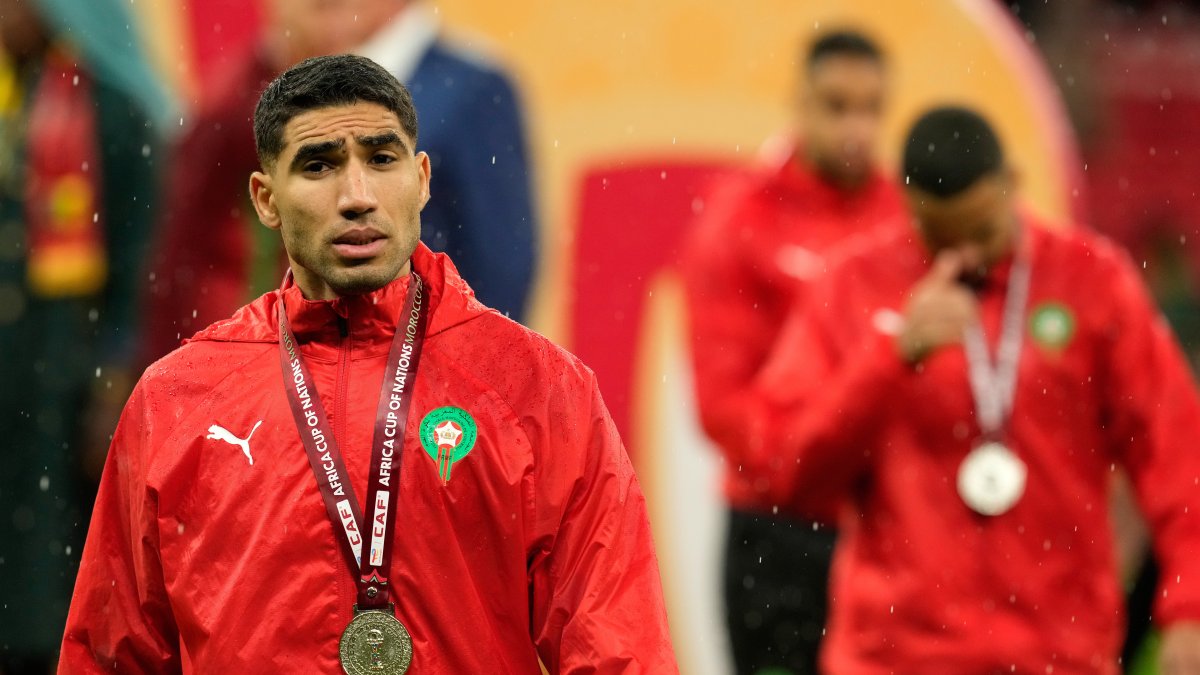
The foregoing mother-son conversation, drawn from a fictional animation circulating online, echoes that journey. It sharpens my reflection on Morocco’s national team captain, Achraf Hakimi, and the quiet, stubborn discipline of a son guided by his mother’s word.
“My mother told me to refuse the Africa Cup of Nations trophy. I am officially refusing it, and I hope my teammates do the same. We had our chance to win it, but we couldn’t,” he said at the weekend.
In our tradition, we say a child who listens to the mother hears tomorrow before it speaks. Hakimi, it would seem, listened.
The Confederation of African Football (CAF) at the weekend announced a decision to overturn the result of the 2026 AFCON final, awarding Morocco a 3–0 victory after ruling that Senegal had forfeited the match.
The ruling, swift, severe, and not without loads of criticisms, was CAF’s ultimate sanction for Senegal’s brief walk-off in Rabat, staged in protest against a disputed stoppage-time penalty awarded to Morocco. It was a decision that, while administrative in form, has left a lingering question about justice in the game.
Hakimi heard CAF and said no. This medal is not mine. There is, in his refusal, a lesson older than football and deeper than sport: that honour is not what is handed to you, but what you are willing to decline. He chose principle over profit; he insisted that Senegal (who won on the field) were the rightful champions. In doing so, he drew a clear line between legality and legitimacy. It is a distinction which Nigeria’s electoral process, and its dispute resolution system, often struggles with.
“Snatch it, grab it, and run with it.” You remember who said this, when and where and the aftermath. We are hearing even scarier promises as we prepare for the next set of elections.
To the utterer of the 2023 erudition in political banditry of snatching, grabbing, and running with the snatched, Hakimi offers a rare lesson in winning or losing with integrity. He offers even more to Nigeria’s entire political class, its electoral umpire, and the judiciary.
Elections may be decided through technicalities, procedural rulings, or judicial interpretations. But beyond the letter of the law lies a deeper question: does the outcome reflect the will of the people?
The stance underscores a simple truth: a decision may be lawful, yet lack moral authority. And when that happens, it risks public rejection.
This is where the judiciary comes in. Like CAF in this case, courts, particularly the Supreme Court, are final arbiters. But finality is not the same as credibility. When rulings appear to contradict what the public perceives as clear outcomes, institutions risk eroding trust. CAF today finds itself embarrassed, its authority intact on paper, but weakened in legitimacy, after both the supposed “winner” and the perceived “loser” rejected its decision.
For INEC, the lesson is clear: credibility must go beyond process to reflect genuine outcomes. For the judiciary, it is a call to ensure that justice is not only done, but seen to align with fairness and common sense. For politicians, the message is simpler still: power gained without legitimacy will always sit uneasily like a bird perched on a fraying rope.
It is in moments like this that sport reasserts its higher purpose. The Hakimi decision is one more reason many insist that sport exists to repair a world repeatedly broken by politics and politicians. And the people know. They will always choose contest over crisis, peace over carnage.
The insight is not new. The French historian, Jean-Baptiste Duroselle, offers a vivid illustration in his masterwork, ‘La Décadence: 1932–1939’. Writing of 1930s France, he observes that “the regiments that had won the First World War received less applause from French crowds when they paraded on July 14 than did the champions and the main pack of riders of the Tour de France that same month.”
The telling comparison, cited in Paul Dietschy’s study, Creating Football Diplomacy in the French Third Republic, 1914–1939, captures a timeless truth: the crowd, weary of war, turns instinctively to play; exhausted by the theatre of power, it seeks the fairness of the field.
Hakimi has shown that leadership is not just about winning; it is about honouring the truth of the contest. And sometimes, the strongest statement a player can make is to refuse a victory that is not truly theirs.

1SUBSCRIBE TO OUR NEWSLETTER NOW
Support MATAZ ARISING’ journalism of integrity and credibility.
Good journalism ensure the possibility of a good society, an accountable democracy, and a transparent government.
We ask you to consider making a modest support to this noble endeavour.
TEXT AD: To advertise here – Email ad@matazarising.com
LATEST POSTS
-
Nigeria’s Economy Under Tinubu: The First Phase Was Stabilisation, Now Comes the Second Phase
By Idowu Ephraim Faleye +2348132100608 MaTaZ ArIsInGDallas, Texas Nigeria has moved from trying to save its economy to the next difficult task of making the economy work for ordinary people. The major economic figures are improving. Government revenue has increased, and state governments are receiving much more money than they received before. Yet many Nigerians…
-
El-Rufai Has Spent Seven Months In Detention Without Conviction – Emir Sanusi
MaTaZ ArIsInGDallas, Texas Sanusi said Nigeria already has institutions and courts responsible for investigating and prosecuting corruption cases, but alleged that political considerations sometimes influence how such cases are handled. The Emir of Kano, Muhammadu Sanusi II, has raised concerns over the continued detention of former Kaduna State Governor, Nasir El-Rufai, saying he has spent…
-
New world record for longest dance marathon set by Nigerian dancer

MaTaZ ArIsInGDallas, Texas Benjamin Daniel, known as Ben Dancer, danced continuously for 168 hours. LAGOS, Nigeria — A Nigerian dancer has broken the world record for the longest individual dance marathon. Benjamin Daniel, known as Ben Dancer, danced continuously for 168 hours. The 33-year-old began the attempt last Tuesday. The previous record of 127 hours…