
Nigeria’s first lady sees ‘divine intervention’ in Trump’s focus on Christians
Nigerian first lady Oluremi Tinubu, an ordained assistant pastor in a Pentecostal church, says global concern about persecution of Christians in the country is based on “propaganda.”
Yet she sees “divine intervention” in President Trump’s focus on protecting Christians in the country, as it has created an opportunity to elevate relations with the United States and tackle insecurity and terrorism in Nigeria.

“Divine in the sense that, who would have even noticed Nigeria? Or to really understand what we are grappling with and trying to build the country?” she asked, speaking with The Hill in an interview Tuesday at the Four Seasons in Georgetown.
Coming more than a month after Trump’s Christmas Day missile strike targeting terrorists in the country, the Nigerian first lady is in Washington, D.C., this week to attend the National Prayer Breakfast, “build relationships” and clear up some misconceptions about religious freedom in Nigeria.
So is Trump being swayed by propaganda about Christian persecution?
“I don’t think so,” Tinubu says. “No one in the free world will hear that Christians have been killed — and U.S. is a Christian country — and you can hear that, and not speak up, or to react.”
Trump’s focus on Nigeria was the result of an intense lobbying campaign among religious freedom advocates and some Republican lawmakers, who celebrated the president’s decision in October to designate Nigeria as a “country of particular concern” (CPC).
Those advocates argue the Nigerian government has not done enough to protect religious communities, particularly Christians, facing criminal violence, terrorist threats and attacks, and that perpetrators are not held accountable.
The CPC designation compels the president to consult with the designated government, draft up a foreign policy action plan, and consult with Congress about implementation — within 90 days.
Nigeria, the most populous African country with an estimated 240 million people, is split between the Muslim-majority north and the Christian-dominated south. Among the 36 governors across Nigeria’s states, 20 are Christians, the first lady points out.
President Bola Ahmed Tinubu, elected in 2023, is a Muslim from the Yoruba ethnic group. President Tinubu is credited with rehabilitating Nigeria’s economy and putting it on a growth track, even as the country is plagued by multiple, overlapping security threats.
This includes a long-running Islamist insurgency in the northeast; separatist violence in the southeast and central regions: violent clashes for resources between Muslim herders and predominantly Christian farmers, which are also fueled by ethnic-religious tensions. Kidnappings for ransom and gang violence further fuel instability.
Following Trump’s designation of Nigeria as a CPC, Tinubu’s government says it has taken action by declaring a national emergency and surging security forces.
The government also enlisted a Republican-connected lobbying firm, DCI Group, to help bolster its image in Washington with a $9 million contract.
“What we have to establish — we are talking about attacks on Christians — we have to realize that Nigeria also is an emerging economy,” the first lady explained.
“There are cases of theft, banditry, kidnapping for ransom, all of those are all intertwined. If kidnappers know that you are focusing on Christians, it now makes them a target for kidnapping, so that they think that they’re being persecuted.”
So is the concern from Trump and others in the U.S. actually making matters worse for Nigeria’s Christians?
“No, there’s nothing wrong with that. It’s a wake-up call for us, we have to really step up what we are doing and make sure lives are secured,” Tinubu says.
Trump has described Christians as facing an “existential threat” in Nigeria at the hands of Islamic terrorists, accused the Nigerian government of allowing Christians to be slaughtered, and threatened to enter the country “guns-a-blazing”.
In November, Trump threatened to cut off “all aid and assistance” to Nigeria if it didn’t take meaningful action. In December, Nigeria’s capital Abuja partnered with the U.S. to identify targets for the Christmas strikes, and the U.S. reportedly launched 16 Tomahawk missiles — at about $2 million each — with 12 reportedly hitting targets. The Washington Post reported that four warheads did not explode and crashed across the country.
Idayat Hassan, special adviser to the National Security Agency for the Nigerian government, joined Tinubu for the interview and said the U.S. strikes destroyed a logistics hub of a “particular strand of the Islamic State” and led to the arrests of “very high caliber ISIS leaders in this area.”
Hassan said the government is not expected to publicize the arrests for a few more months. A report in the Nigerian newspaper Vanguard said security officials arrested 39 suspected terrorists who fled Sokoto state following the Christmas Day strikes.
Some analysts have raised concerns that the U.S. strikes may have strengthened terrorist recruitment narratives against foreign intervention and questioned whether the attacks advanced American objectives.
“I’m not a security person,” Tinubu said when asked if U.S. military intervention is the best way to combat threats from terrorists.
“I believe that the relationship we want to build with America, now that we have your attention, is to build a relationship on trade, and also security. Because we can’t have good trade relationship if your investment is not secured.”
The U.S. is deepening its engagement in Nigeria, both militarily and politically.
Commander of U.S. Africa Command, Gen. Dagvin Anderson, told reporters Tuesday that there is a small U.S. team on the ground in Nigeria “in order to augment what Nigeria has been doing for several years.”
This follows joint U.S.-Nigeria talks about its status as a country of particular concern in Abuja on Jan. 22, headed by Under Secretary of State for Political Affairs Allison Hooker. The U.S. also carried out a commercial and investment partnership dialogue on Jan. 30, and in December, the two countries signed a bilateral health memorandum for the U.S. to provide about $5.1 billion over five years.
“I’ve always believed that all things work together for good, despite I didn’t want this attention, but at least I have to speak my truth, that’s why I came,” the first lady said.
“We really thank God that he looked at that and we can look for ways to move forward.”
Tinubu’s visit coincides with a larger spotlight in the capital this week on advocating international religious freedom around the world.
The International Religious Freedom (IRF) Summit took place this week in Washington, D.C., where a number of organizers and sponsors who attended the summit have supported Nigeria’s designation as a CPC.
Among its headliners was U.S. Ambassador to the United Nations Mike Waltz, who was highlighted for his advocacy surrounding the persecution of Christians in Nigeria and partnership with Grammy-award winning rapper Nicki Minaj to raise awareness.
“It has created a torchlight on religious issues in Nigeria,” Funke Adeoye, founder and executive director of Hope Behind Bars Africa, which provides legal support to those who can’t afford it, said of Trump’s focus on the country.
Adeoye, who spoke on a panel at the IRF summit, credited U.S. intervention as pushing the Nigerian government to prioritize the arrests of perpetrators of violence against Christians, arguing that judicial reform is needed to help address religious persecution.
“Oftentimes when you go to the news and you see the cases of these destruction, but we never see people being prosecuted. It’s interesting to see that people are being prosecuted,” she said.
“Back home, people are polarized around if we really needed to be designated [as a country of particular concern], but that’s a different conversation … the broader conversation is of strengthening the justice system.”

1SUBSCRIBE TO OUR NEWSLETTER NOW
Support MATAZ ARISING’ journalism of integrity and credibility.
Good journalism ensure the possibility of a good society, an accountable democracy, and a transparent government.
We ask you to consider making a modest support to this noble endeavour.
TEXT AD: To advertise here – Email ad@matazarising.com
LATEST POSTS
-
Peter Obi Faces Petition for Allegedly Travelling with Passenger Using Fake Identities
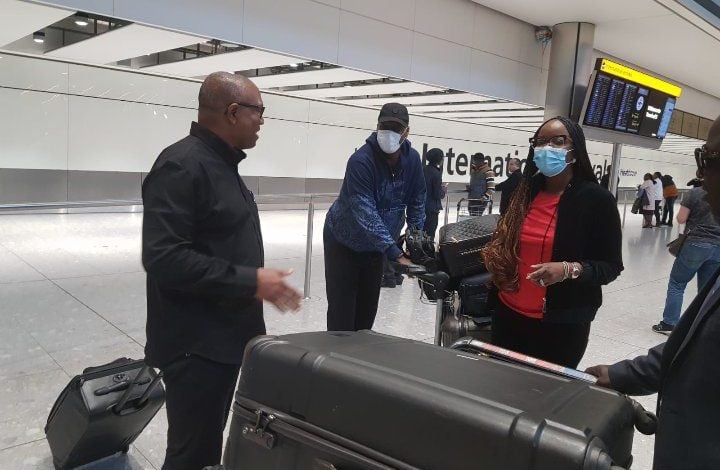
MaTaZ ArIsInGDallas, Texas A fresh petition has been submitted to the Minister of Aviation and Aerospace Development, Festus Keyamo, calling for an investigation into Nigeria Democratic Congress (NDC) presidential candidate Peter Obi over allegations that he repeatedly travelled with a passenger who allegedly used fake identities to board flights. The petition, dated July 12, 2026,…
-
Afrophobia: Should Nigeria ask South African companies to leave?

MaTaZ ArIsInGDallas, Texas Monday Lines 2 Afrophobia: Should Nigeria ask South African companies to leave? By Lasisi Olagunju (Published in the Nigerian Tribune on Monday, 6 July, 2026). Jacob Zuma was President of South Africa when he declared on October 21, 2013 that South Africa should not “think like Africans in Africa, generally.” The remark,…
-
Why I did not take Brazil’s penalty against Norway – Vinicius
MaTaZ ArIsInGDallas, Texas Brazil’s hopes of ending their long wait for World Cup glory came to a painful end after a 2-1 defeat to Norway in the Round of 16, with Erling Haaland scoring twice to eliminate the five-time champions. The aftermath of the defeat was dominated by questions over why Vinicius Júnior did not…