
Nigeria is moving to become one of the first African countries to formally regulate artificial intelligence (AI), as lawmakers prepare to pass legislation that would tighten oversight of a fast-growing digital sector long dominated by global technology firms.

The proposed National Digital Economy and E-Governance Bill would give regulators broad powers over data use, algorithms and digital platforms, filling a regulatory gap that has persisted since Nigeria released a draft national AI strategy in 2024.
Lawmakers expect to approve the bill by the end of March.
Under the proposal, higher-risk AI systems — including those deployed in finance, public administration, surveillance and automated decision-making — would face stricter scrutiny. Developers would be required to submit annual impact assessments detailing risks, mitigation measures and system performance.
The bill would also allow regulators to impose fines of up to 10 million naira ($7,000) or as much as 2% of an AI provider’s annual revenue generated in Nigeria, although it does not specify how penalties would be calculated or enforced.
The legislation is designed to regulate AI early rather than retroactively, as adoption accelerates across Nigeria’s financial sector, public services and private industry, according to Kashifu Abdullahi, director-general of the National Information Technology Development Agency (NITDA).
“If passed, Nigeria would be among the first African countries to adopt an economy-wide regulatory framework for artificial intelligence,” Abdullahi said in an interview with Bloomberg.
Several African countries, including Mauritius, Egypt and Benin, have published AI strategies, but few have enacted comprehensive legislation governing the technology.
The proposed law sets ethical standards around transparency, fairness and accountability, and adopts a risk-based approach similar to regulatory frameworks emerging in Europe and parts of Asia. That could reshape how multinational technology companies — from US-based firms such as Google to Chinese cloud providers — operate in Africa’s most populous country.
“In governance, we need safeguards and guardrails to ensure the AI we build operates within acceptable boundaries,” Abdullahi said. “That way, bad actors can be detected and contained.”
The bill would empower regulators to demand information from AI providers, issue enforcement directives and suspend or restrict systems deemed unsafe or non-compliant. It also provides for regulatory “sandboxes”, allowing startups and institutions to test AI systems under supervision in an effort to balance oversight with innovation.
“Regulation is not just about giving commands,” Abdullahi said. “It’s about shaping market and societal behaviour so people can build AI for good.”

1SUBSCRIBE TO OUR NEWSLETTER NOW
Support MATAZ ARISING’ journalism of integrity and credibility.
Good journalism ensure the possibility of a good society, an accountable democracy, and a transparent government.
We ask you to consider making a modest support to this noble endeavour.
TEXT AD: To advertise here – Email ad@matazarising.com
LATEST POSTS
-
‘Desist from deceiving Nigerians with sanctimonious sermons’, Presidency blasts Peter Obi
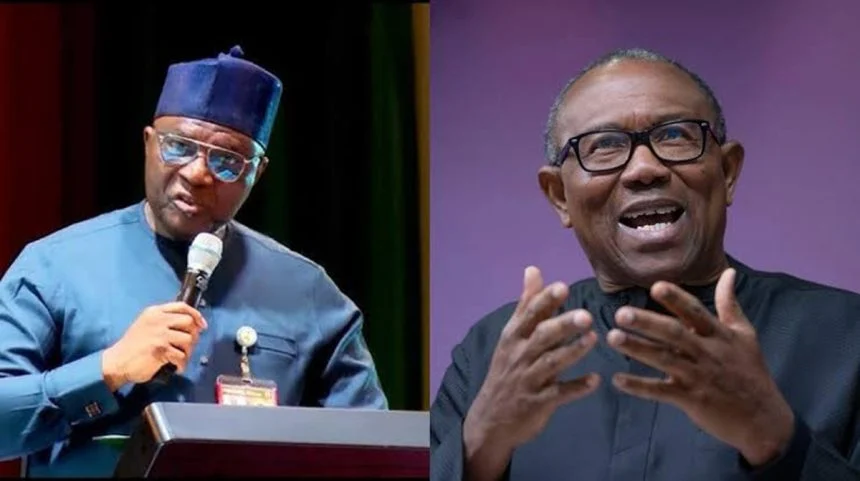
MaTaZ ArIsInGDallas, Texas Special Adviser to President Bola Tinubu on Information and Strategy, Bayo Onanuga, has told the presidential candidate of the Nigeria Democratic Congress (NDC), Peter Obi, to stop deceiving Nigerians with what he described as “sanctimonious sermons.” Onanuga made the comment in a post on his verified X handle on Thursday while reacting…
-
FAAC: FG, states, LGAs share N2.338trn as August 2026 revenue
MaTaZ ArIsInGDallas, Texas The Office of the Accountant General of the Federation has disclosed that a total sum of N2.338 trillion, being August 2026 Federation Account Revenue, has been shared to the Federal Government, States and the Local Government Councils. In a statement signed by Bawa Mokwa, the Director (Press and Public Relations), the revenue…
-
2027: Obi, Kwankwaso Movement unveils 59-member presidential campaign council
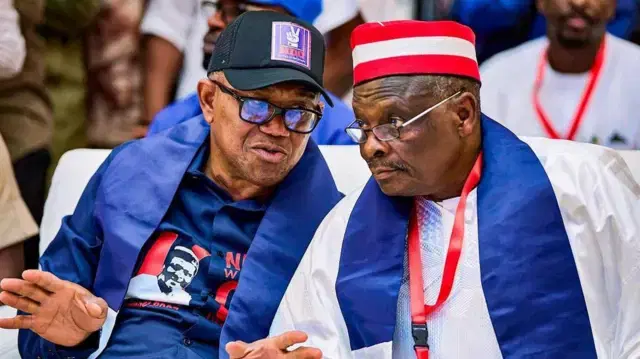
MaTaZ ArIsInGDallas, Texas ABUJA- The OK Movement, a political platform established to mobilise support for the joint ticket of the Nigeria Democratic Congress presidential candidate, Peter Obi, and his running mate, Dr Rabiu Kwankwaso, has put in place a 59-member Presidential Campaign Council comprising zonal and state coordinators. By Henry Henry The group has also…