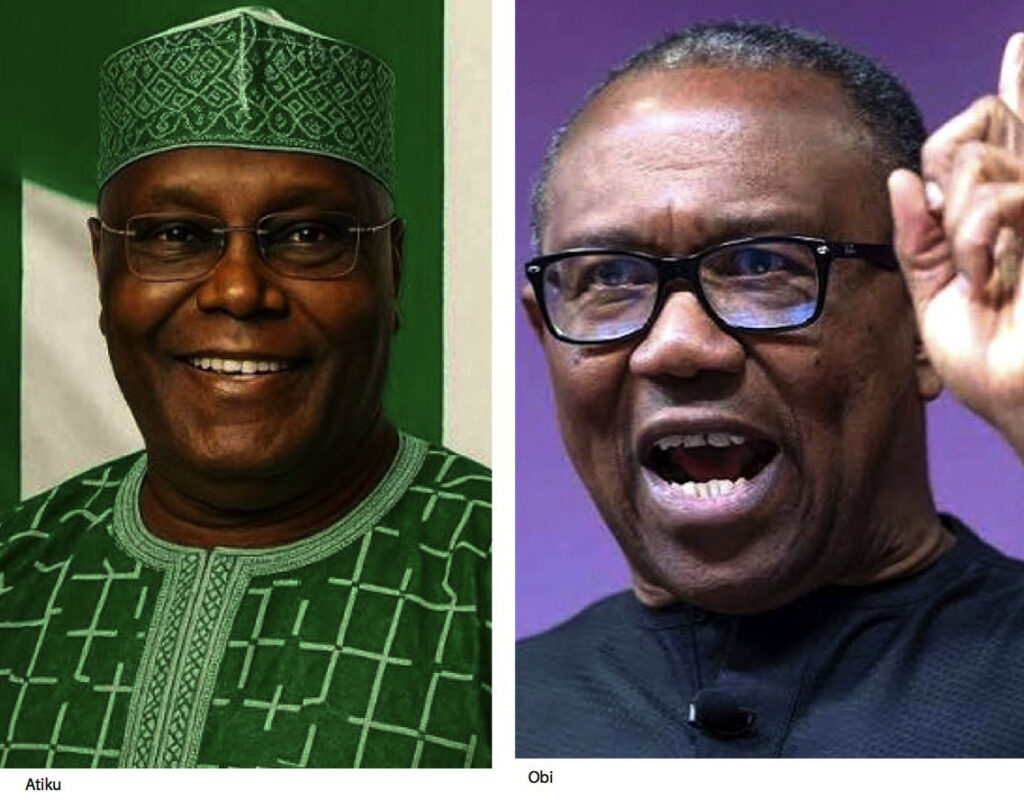
Nigeria’s 2027 presidential contest is gradually raising an uncomfortable question for Peter Obi; what happens when the political space he occupied so successfully in 2023 begins to be occupied by somebody else?
Obi is certainly not out of the race. He remains the presidential candidate of the Nigeria Democratic Congress (NDC), with Rabiu Kwankwaso as his running mate, and the duo are already mobilising their structures across the country.
From Sola Ojo, Abuja
As recently as September 1, Obi and Kwankwaso met with the NDC’s candidates from different states to strategise on taking their message to rural communities and the hinterlands.
But politics is not only about whether a candidate is still standing, but it is also about whether voters still see that candidate as the most compelling alternative.
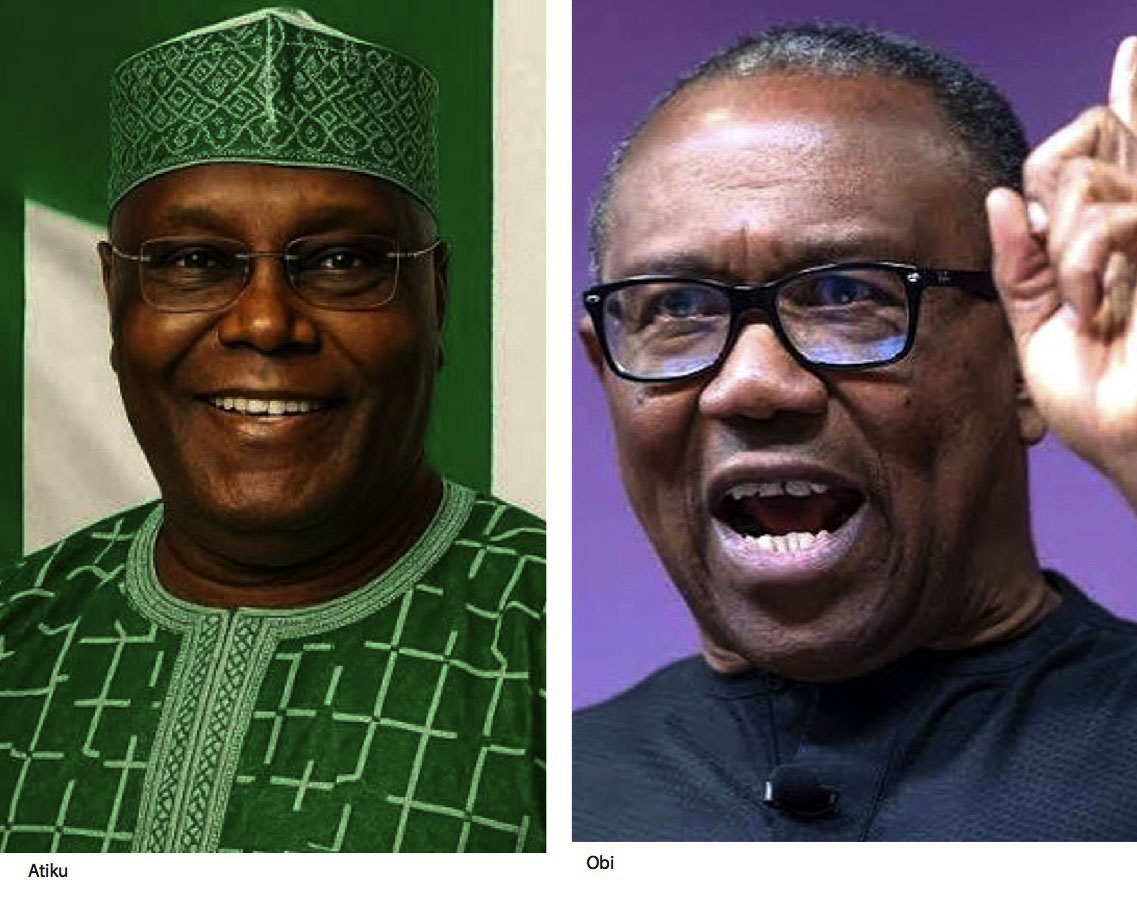
And this is where former vice president Atiku Abubakar’s emerging strategy, attacking President Bola Tinubu from two politically sensitive directions: the economic hardship associated with petrol subsidy removal and the controversy over historical US law-enforcement records concerning allegations of drug trafficking involving Tinubu, becomes important.
Both issues allow Atiku to present himself as the opposition figure most directly challenging the president. So if there is anything Atiku appears to have learned, it is how to campaign to Nigerians’ emotions and deepest desires, much as the political narrative was shaped in the years leading up to Muhammadu Buhari’s victory in 2015.
He seemed to have understood that beyond policies, statistics and political calculations, Nigerians respond strongly to messages that speak directly to their frustrations, hopes and aspirations. His recent messaging increasingly taps into the mood of a population yearning for economic relief, good governance and a sense of renewed national direction.
In that respect, Atiku appeared to be rediscovering the power of emotional politics, the kind that can turn widespread dissatisfaction into a potent electoral force like what Obi himself enjoyed in some parts of the country in the 2023 presidential election he contested on the platform of the troubled Labour Party.
For millions of Nigerians who are unable to drive their cars as desired, petrol subsidy is not an economic theory but an economic reality they yearn to overcome. In Nigeria, petrol is everything. Transport fare is now out of reach for many Nigerians.
Although the APC-led federal government has said repeatedly that Tinubu’s administration has stabilize macro economy, which they believe will, over time, have a ripple effect on the microeconomy where the majority of Nigerians fall.
So when Atiku said he would restore subsidy if elected in 2027, he is speaking directly to the pocket of the ordinary Nigerians who are unable to feed well due to the high cost of petrol, from less than N200 when Tinubu took over in 2023 to over N1,300 and still counting.
Atiku has insisted that the policy he proposed would be targeted and designed to make fuel more affordable, rather than simply returning to the old system.
Politically, that was a powerful message in a country where the removal of subsidy has become one of the defining symbols of the economic pain of the Tinubu years in government so far.
But then Peter Obi entered the debate, and surprisingly, he took a position that puts him closer to Tinubu’s original economic argument than Atiku’s.
To him, subsidy removal was necessary, especially as all the top presidential candidates said in the run-up to the 2023 general election, including Atiku.
He objected that the government failed to properly manage and invest the savings and failed to provide sufficient alternatives to cushion Nigerians from the consequences. That difference is politically significant but seems not to matter to Nigerians who are not ready for economic analysis, at least for the time being.
Atiku’s promise: “I will restore fuel subsidy and make fuel cheaper,” was all he needed to put Tinubu and APC on the hot defence seats, and this is where Atiku may be unintentionally squeezing Obi out of the equation.
The former vice president is taking ownership of the immediate pain narrative, while Obi is trying to explain the structural economic argument behind the pain.
And Nigerians who are struggling to survive may not have the patience for complicated economic explanations and statistical comparisons Obi has been enjoying in the past few years.
Atiku’s second move is even more politically consequential; his campaign has been involved in efforts surrounding the release of US records relating to historical investigations involving Tinubu.
The FBI has asked a US court to permit confidential explanations for withholding some records, citing exemptions under the Freedom of Information Act. The records relate to investigations from the 1990s.
It is important to make one distinction clear: the existence of an investigation or withheld records is not, by itself, proof that Tinubu committed drug trafficking or any other offence. That distinction matters because this is an allegation-driven political controversy, not a judicial finding of guilt.
The controversy is now becoming part of the 2027 political conversation, with other opposition groups also demanding the release of the records. The Allied Peoples Movement, for instance, recently called on US authorities to release the FBI report.
Tinubu’s legal team has argued that the election should ultimately be decided by campaign promises rather than documents and has defended reliance on legal protections governing the withheld material.
The more the opposition conversation revolves around Tinubu’s past, the more the voters are drawn into emotions, and of course the more the contest risks becoming a straightforward question like who can defeat Tinubu? And that again is precisely where Atiku has an advantage over Obi.
Atiku has spent decades inside Nigeria’s political establishment, and he has contested the presidency under all the major political parties several times.
He has a national political network and, through the ADC, is positioning himself around the argument that he is the experienced opposition figure capable of taking on the APC and incumbent Tinubu.
The bottom line is that Atiku is gradually occupying the political space Obi once owned by walking into the heart of many Nigerians as far as their livelihood is concerned.

1SUBSCRIBE TO OUR NEWSLETTER NOW
Support MATAZ ARISING’ journalism of integrity and credibility.
Good journalism ensure the possibility of a good society, an accountable democracy, and a transparent government.
We ask you to consider making a modest support to this noble endeavour.
TEXT AD: To advertise here – Email ad@matazarising.com
LATEST POSTS
-
Nigeria’s Economy Under Tinubu: The First Phase Was Stabilisation, Now Comes the Second Phase
By Idowu Ephraim Faleye +2348132100608 MaTaZ ArIsInGDallas, Texas Nigeria has moved from trying to save its economy to the next difficult task of making the economy work for ordinary people. The major economic figures are improving. Government revenue has increased, and state governments are receiving much more money than they received before. Yet many Nigerians…
-
El-Rufai Has Spent Seven Months In Detention Without Conviction – Emir Sanusi
MaTaZ ArIsInGDallas, Texas Sanusi said Nigeria already has institutions and courts responsible for investigating and prosecuting corruption cases, but alleged that political considerations sometimes influence how such cases are handled. The Emir of Kano, Muhammadu Sanusi II, has raised concerns over the continued detention of former Kaduna State Governor, Nasir El-Rufai, saying he has spent…
-
New world record for longest dance marathon set by Nigerian dancer

MaTaZ ArIsInGDallas, Texas Benjamin Daniel, known as Ben Dancer, danced continuously for 168 hours. LAGOS, Nigeria — A Nigerian dancer has broken the world record for the longest individual dance marathon. Benjamin Daniel, known as Ben Dancer, danced continuously for 168 hours. The 33-year-old began the attempt last Tuesday. The previous record of 127 hours…