

Former Nigerian Head of State General Yakubu Gowon has shed new light on the collapse of the historic Aburi Accord, claiming that his eastern counterpart, Chukwuemeka Odumegwu Ojukwu, misrepresented the terms of the agreement in a manner that derailed hopes of national unity and contributed to the outbreak of the Nigerian Civil War.

Speaking during an interview on Arise Television on Wednesday, Gowon recounted the tense atmosphere that followed the January 1967 peace talks held in Aburi, Ghana. The talks were convened to ease the political crisis threatening to splinter Nigeria in the aftermath of two coups and growing regional mistrust.
Gowon (the head of state) and Ojukwu (then military governor of the Eastern Region), were key players in the discussions.
Gowon said that while the intent of the Aburi meeting was to return home and finalize the resolutions together, Ojukwu immediately made public pronouncements that, according to him, were not aligned with what was actually agreed upon.
“We just went there, as far as we were concerned, to meet as officers and then agree to get back home and resolve the problem at home. That was my understanding,” Gowon said. “But that was not his (Ojukwu’s) understanding.”
The retired general, who led Nigeria from 1966 to 1975, said he fell seriously ill with fever shortly after returning from Aburi, which prevented him from immediately engaging in follow-up deliberations. During that time, he claimed Ojukwu moved quickly to present a version of the accord that surprised many of his fellow officers.
“I don’t know where he got his version from,” Gowon said, a note of bewilderment in his voice.
At the heart of the disagreement, according to Gowon, was the issue of military control. Ojukwu, he alleged, proposed that regional military zones be placed under the command of regional governors, a structure that would have effectively decentralized control of the armed forces.
“That was one of the major issues,” Gowon explained. “We said that the military would be zoned, but he wanted those zones to be commanded by the governor of each region. Of course, we did not agree with that one.”
Gowon also noted that a follow-up meeting was arranged in Benin City to clarify lingering ambiguities in the agreement. All regional leaders, including Ojukwu, were invited. But the Eastern Region governor declined, citing security concerns.
“We needed to review and agree collectively on the next steps. But he refused to come,” Gowon said.
The Aburi meeting, held from January 4–5, 1967, was one of the last-ditch efforts to preserve Nigeria’s unity in the face of mounting ethnic tensions, military mutinies, and regional secessionist sentiment. Both federal and eastern delegates agreed in principle that regions should have autonomy in managing their affairs, but the specifics, especially regarding the chain of command and national sovereignty, remained contentious.
The failure to implement the accord ultimately paved the way for the declaration of the Republic of Biafra on May 30, 1967, by Ojukwu and the onset of a brutal civil war six weeks later. The conflict, which lasted until January 15, 1970, claimed an estimated one to three million lives, many from starvation in the war-ravaged eastern region.
Though more than five decades have passed since the accord and the war, interpretations of Aburi remain divisive. To some, it symbolized a missed opportunity for a more decentralized, federal Nigeria. To others, it exposed the fault lines and distrust that no agreement, however well-intentioned, could mend.
Ojukwu, the man at the centre of that critical moment in Nigerian history, died in 2011 at the age of 78. His legacy, like that of Aburi, remains both revered and contested.
For Gowon, now in his 80s, the lessons of that era still resonate. “We wanted peace,” he said in the interview. “But peace must come with clarity and shared understanding. That, sadly, is where we fell short.”

1SUBSCRIBE TO OUR NEWSLETTER NOW
Support MATAZ ARISING’ journalism of integrity and credibility.
Good journalism ensure the possibility of a good society, an accountable democracy, and a transparent government.
We ask you to consider making a modest support to this noble endeavour.
TEXT AD: To advertise here – Email ad@matazarising.com
LATEST POSTS
-
Police raid Abuja crime hideouts, arrest 300 suspects
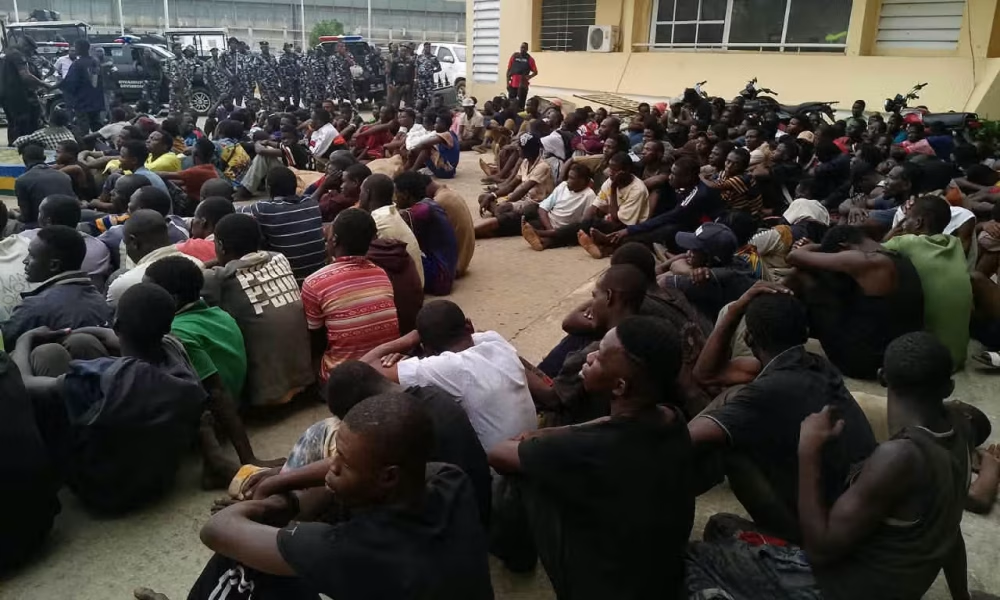
MaTaZ ArIsInGDallas, Texas The Federal Capital Territory, FCT, Police Command has arrested about 300 suspects during raids on crime-prone areas, shanties and uncompleted buildings across Abuja. The operation, carried out on Saturday, September 19, was aimed at identifying and disrupting criminal activities in locations suspected to serve as hideouts for criminals. The command’s spokesperson, Josephine…
-
How Malami went from calling Mambilla claimant ‘criminal’ to pushing $400m deal – ICC
MaTaZ ArIsInGDallas, Texas FORMER Attorney-General of the Federation, Abubakar Malami, reversed his position on Sunrise Power and backed a settlement that could have exposed Nigeria to $400 million, despite previously describing the company’s promoter, Leno Adesanya, as a “criminal of the highest order,” an International Chamber of Commerce (ICC) tribunal has revealed. The tribunal said…
-
CPPE says Nigeria retail trade faces growing foreign competition
MaTaZ ArIsInGDallas, Texas The Centre for the Promotion of Private Enterprise (CPPE) has raised concerns over how foreign traders, particularly Chinese nationals, are expanding their presence in Nigeria’s retail and distributive trade. The concerns was contained in a policy brief issued on Sunday by the Chief Executive Officer of CPPE, Dr. Muda Yusuf who stated…